I just told a friend that this is one of the best weekends of my year. It is the weekend of the fall choir concert. The life-changing piece on this season's program? Tres Cantus Laudendi (Three Songs of Praise) by Mack Wilburg.
 OK there was a long, tearful interlude right there while I went to listen to the full performance of the piece, which is available in practice files on our chorus's website, but here's a youtube video of the first movement in performance. I just can't believe what an experience it is to sing in a choir of 100 people, accompanied by 8 or 10 brass players. I can't even hold it together. Pardon me with the Tribune's review says all was well except the insufferable second alto who couldn't keep from swaying and bobbing this moment, then crumpling into emotional tears at other moments. Thank goodness for dress rehearsals when the first wave of the impact of combined choir and orchestra can be undergone without an audience.
The dress rehearsal is indeed my favorite night of the year (which is why Holy week was so great last week, with what was essentially a dress rehearsal for the St. Matthew Passion every night) because without an audience I feel less nervous and inhibited. I also love hearing the brass rehearse, stop, try something again, get better. The rehearsal process (and watching Brady be exacting with all the other musicians as well) is so satisfying.
I just wish that I could believe that watching the concert is anywhere near as enjoyable as participating in it! I feel compelled to buy tickets for anyone who is kind enough to humor me by attending.
In another context (the classroom), I feel like singing songs of praise to Shakespeare this week. Othello, co-taught with Monica, has been so enjoyable. One interesting tidbit was that yesterday, after the first two periods didn't really get into the piece of text we were studying, I realized I wasn't giving them enough to connect to their own lives. The passage was about Othello's initial wooing of Desdemona, which he conducted by telling her stories of his adventures. Then, she arrives on stage and tells her father, in front of the Duke and Lords of Venice, that her duty is divided between him, the patriarch, and her husband ("I do perceive her a divided duty").
The issues at hand - flirting, and allegiance to husband or father - are ones that are near the top of the teenage brain. I probably wouldn't say that about the allegiance to husband or father idea if I were at another Utah school, but so many of our students are from more traditional communities where girls marry younger, and where marriages are arranged to one degree or another.
So for third period we started with two discussion questions ("No writing right now, just discussing at your tables")
1. How can a man capture a woman's attention and interest?
and, two minutes later,
2. Should a woman be more obedient to her father, or her husband?
For #1, it was great to see how differently the young men and women saw this issue. Men said, make money, drift in nice cars, give compliments. Women said be consistent, have a plan for the future, be respectful, include the woman in decisions.
For #2, many said husband, but many said father, because the husband might not stick around, but the father will always be there. Some articulated that it depends on the relationship with the father, since the daughter may want to get away.
And, in one of the most interesting moments of the day, L., who moved to the U.S. maybe a year and a half ago, said that the couple can just move, if need be, to another state, to live in peace. I'm so fascinated that she would have understood and sort of taken in this reality of American society, which was likely not a reality in Rwanda: if you don't get along with your family, you can move away from them and start afresh!
In both 3rd and 4th periods, the discussion of the text which followed ("So, how does Othello get Desdemona's attention?" and "Whom should Desdemona remain close to, her father Brabantio, or her husband Othello?") had much more energy.
OK there was a long, tearful interlude right there while I went to listen to the full performance of the piece, which is available in practice files on our chorus's website, but here's a youtube video of the first movement in performance. I just can't believe what an experience it is to sing in a choir of 100 people, accompanied by 8 or 10 brass players. I can't even hold it together. Pardon me with the Tribune's review says all was well except the insufferable second alto who couldn't keep from swaying and bobbing this moment, then crumpling into emotional tears at other moments. Thank goodness for dress rehearsals when the first wave of the impact of combined choir and orchestra can be undergone without an audience. The dress rehearsal is indeed my favorite night of the year (which is why Holy week was so great last week, with what was essentially a dress rehearsal for the St. Matthew Passion every night) because without an audience I feel less nervous and inhibited. I also love hearing the brass rehearse, stop, try something again, get better. The rehearsal process (and watching Brady be exacting with all the other musicians as well) is so satisfying.
I just wish that I could believe that watching the concert is anywhere near as enjoyable as participating in it! I feel compelled to buy tickets for anyone who is kind enough to humor me by attending.
In another context (the classroom), I feel like singing songs of praise to Shakespeare this week. Othello, co-taught with Monica, has been so enjoyable. One interesting tidbit was that yesterday, after the first two periods didn't really get into the piece of text we were studying, I realized I wasn't giving them enough to connect to their own lives. The passage was about Othello's initial wooing of Desdemona, which he conducted by telling her stories of his adventures. Then, she arrives on stage and tells her father, in front of the Duke and Lords of Venice, that her duty is divided between him, the patriarch, and her husband ("I do perceive her a divided duty").
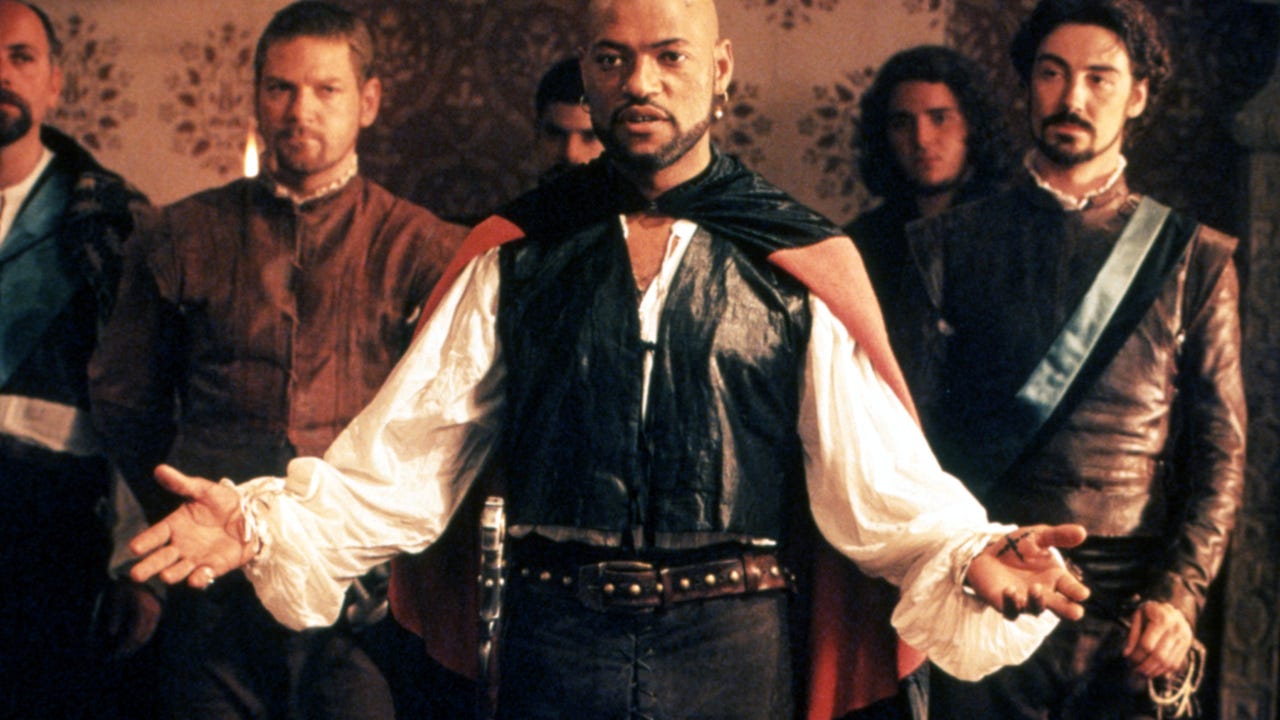 |
| Othello, explaining his love for Desdemona to the Venetian court |
So for third period we started with two discussion questions ("No writing right now, just discussing at your tables")
1. How can a man capture a woman's attention and interest?
and, two minutes later,
2. Should a woman be more obedient to her father, or her husband?
For #1, it was great to see how differently the young men and women saw this issue. Men said, make money, drift in nice cars, give compliments. Women said be consistent, have a plan for the future, be respectful, include the woman in decisions.
 |
| Desdemona chooses Othello: "But here's my husband." |
And, in one of the most interesting moments of the day, L., who moved to the U.S. maybe a year and a half ago, said that the couple can just move, if need be, to another state, to live in peace. I'm so fascinated that she would have understood and sort of taken in this reality of American society, which was likely not a reality in Rwanda: if you don't get along with your family, you can move away from them and start afresh!
In both 3rd and 4th periods, the discussion of the text which followed ("So, how does Othello get Desdemona's attention?" and "Whom should Desdemona remain close to, her father Brabantio, or her husband Othello?") had much more energy.


No comments:
Post a Comment