I have been brought to tears twice in the past two days by stories of immigrants newly arrived in America. But these are not the oft-published stories of grand injustices like the tearing apart of families or the withholding of housing, jobs, or rights in court.
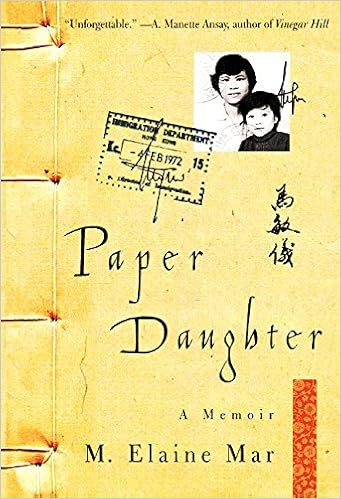 The first comes from Paper Daughter, by M. Elaine Mar. Five-year-old Yee arrives in Denver with her mother, following after her father who departed from China years before. Nixon is in office, we learn for a sense of timing, and Yee joins an all-white first grade classroom.
The trials of school are almost incommunicable but Mar poignantly and impressively details the difficulty of answering a question in math class:
Mrs. Tate wrote the equation in big chalk figures on the board. She asked for a volunteer. The more enthusiastic students raised their hands. Mrs. Tate scanned the room, then decided, "Let's give Elaine a chance." I didn't understand a word, not even my new name. There was silence. "Elaine?" Mrs. Tate repeated. I ddin't respond. "That's your name," San reminded me. My classmates started giggling. "Oh," I said. I immediately knew the answer, but I couldn't think of the word for "seven" in English. "Um," I said. The children laughed some more.
Mrs. Tate made a shushing sound, one finger in front of her lips. She drew tally marks next to the numbers. "Now, here we have one, two, three," she said. "And here we have one, two three, four. If we put them together, how many do we have?" She looked at me significantly.
I still couldn't think of the word. I wanted to ask San, but I wasn't allowed - Mrs. Tate would think I was cheating. I'll write it on the board, I thought. I slid out of my seat.
Misunderstanding my action, Mrs. Tate said, "No, no, you can't go to the bathrom now." The class exploded with laughter. San translated the sentence for me. "I want to write the answer," I told him.
Too late. Mrs. Tate decided to solve the problem herself: "All together class, one, two, three --" she tapped at the lines she'd drawn "--four, five, six, seven. The answer's seven!"
As I read this I think of students who don't respond right away when their names are called - students who have read the text and probably have understood, but who can't speak their words. This is why I so rarely cold call. But I am afraid that I must often not give students enough time to respond to a question that just takes them time to translate in their heads, then translate back into English.
This isn't the scene that made me cry - that was the scene when the whole class submits forms and money to buy school-logo tee-shirts which Elaine's family cannot afford. Her shame, instead of her lack of English, prevent her from being clear about why she can't submit the form on time. This kind of shame must be the experience of so many kids, immigrant and not.
The other immigrant story is this excerpt from 'Tis: A Memoir by Frank McCourt. The excerpt appeared in the New Yorker in 1999 and has been reprinted this week. At first I thought it was just going to be an enjoyable and light read. But the final scene, which is indeed funny, and describes his mishaps in a New York movie theater a few days after he's arrived from Ireland, is also very sad. The pain of having an expectation of how you will enjoy simple pleasures, and having that expectation so utterly smashed, is hard to read about. OK I didn't actually cry, but I felt like crying, and certainly had I been in his shoes I think I would have cried.
The trials of school are almost incommunicable but Mar poignantly and impressively details the difficulty of answering a question in math class:
Mrs. Tate wrote the equation in big chalk figures on the board. She asked for a volunteer. The more enthusiastic students raised their hands. Mrs. Tate scanned the room, then decided, "Let's give Elaine a chance." I didn't understand a word, not even my new name. There was silence. "Elaine?" Mrs. Tate repeated. I ddin't respond. "That's your name," San reminded me. My classmates started giggling. "Oh," I said. I immediately knew the answer, but I couldn't think of the word for "seven" in English. "Um," I said. The children laughed some more.
Mrs. Tate made a shushing sound, one finger in front of her lips. She drew tally marks next to the numbers. "Now, here we have one, two, three," she said. "And here we have one, two three, four. If we put them together, how many do we have?" She looked at me significantly.
I still couldn't think of the word. I wanted to ask San, but I wasn't allowed - Mrs. Tate would think I was cheating. I'll write it on the board, I thought. I slid out of my seat.
Misunderstanding my action, Mrs. Tate said, "No, no, you can't go to the bathrom now." The class exploded with laughter. San translated the sentence for me. "I want to write the answer," I told him.
Too late. Mrs. Tate decided to solve the problem herself: "All together class, one, two, three --" she tapped at the lines she'd drawn "--four, five, six, seven. The answer's seven!"
As I read this I think of students who don't respond right away when their names are called - students who have read the text and probably have understood, but who can't speak their words. This is why I so rarely cold call. But I am afraid that I must often not give students enough time to respond to a question that just takes them time to translate in their heads, then translate back into English.
This isn't the scene that made me cry - that was the scene when the whole class submits forms and money to buy school-logo tee-shirts which Elaine's family cannot afford. Her shame, instead of her lack of English, prevent her from being clear about why she can't submit the form on time. This kind of shame must be the experience of so many kids, immigrant and not.
 |
| “You may have ‘The Lives of the Poets’ under your oxter, but you don’t have them in your head, so go home and read.” |


