Saturday, July 6, 2019

What happens between the invasions

When we tell our own stories, and especially when we tell the stories of countries or empires, it is easy to use the big, sometimes catastrophic events as the only reference points. "I moved here, lost this job, moved here, divorced, got sick, this person died, then I moved here. And here I am!" Or, with a history lesson about a country, "Iran was part of the Persian empire, then was invaded by the Ottomans, and then the Mongols..." (I don't actually know if that order is correct). 

I went to a talk last night on Iran, and the presenter made some reference to the culture of Iran between the invasions that dominate its timeline. I much appreciated this. It made me think of how fiction illuminates the small dramas that give substance and animism to our lives. And not only that, but they highlight the dynamism of our inner lives - how we think, obsess, decide, ponder, worry, etc. 

So this video gives a sense of contemporary Iranian history, using the timeline approach (I love John Green)

       
And this movie gives a sense of one family's drama. 


I also read about this musical, which, while telling no story, reveals such an important part of the human experience by revealing some of our common neuroses. I am especially interested that the characters on stage in addition to the protagonist are the voices in his brain. From the review: 

the only other characters in the show are Usher’s “Thoughts,” six hilarious, hyper-verbal, endlessly cruel archetypical shape-shifters. One moment, they’re abstract entities—self-loathing, sexual ambivalence, financial mishandling.

Thank goodness for art for showing us what goes on between the invasions and wars.

Wednesday, July 3, 2019

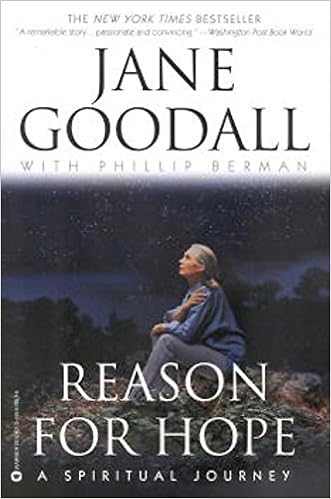
Jane Goodall, Reason for Hope

Jane Goodall's memoir, Reason for Hope, took a surprising and distressing turn yesterday. She describes how, after ten years of observing the chimpanzees at the Gombe Stream Research Center, she and the other researchers began observing brutally aggressive behavior in the chimps. 

Image result for jane goodall reason for hopeSome of the adult males began beating up adult females with infants. They would often kill the infant. They would beat up the female. She often died of her injuries. Women also attacked other females, and even ate their babies. When one community broke into two groups at opposite ends of the reserve, one group continually attacked individual members of the other group while they were alone, until the breakaway troupe was all but annihilated. 

Goodall found these events difficult not only because she knew these animals well and it was hard to see them turn on each other in such violence, but also because of the implications of these observations on their understanding of chimp nature. She was encouraged not to publish her findings, since publication would certainly provide fodder for scientists eager to justify human violence by claiming it was inherent in our genetic nature, inherited from our ape-like ancestors. 

She published anyway, and this did in fact come to pass. Chimpanzees had a dark side to their nature, which illuminated some aspects of our own dark nature. 

It is interesting to consider for oneself, quite free of scientific research, whether one thinks humans are naturally peaceful or naturally aggressive and hateful. I would say no, first off, but really there is overwhelming evidence on both sides of the argument. Children offer gifts and love freely and naturally. They also divide into factions and work for others' destruction. Adults do love each other, and especially their own children. They also create many artificial ways of separating themselves from others and justifying violence toward the "other" groups. 

The chimps Goodall observed behaved not just to protect themselves, but to inflict major pain and suffering on each other. Does that mean this is what we will naturally do, after a time? 

Marianne Williamson says "When people behave unlovingly, they have forgotten who they are." Is this what happened to the chimps? Our amnesia can be quite powerful, as induced by fear and socialization. I think it pretty conceivable that we can be "asleep at the wheel" and act in ways not in tune with our true nature. I hope that is where our violence comes from, not from our innate hatred of the other.

Here's a little video summary of the section I listened to yesterday. 


I take comfort in the fact that I'm only half way through the book, and the title is Reason for Hope, so there must be a compelling uplift from this depressing revelation about chimps - that they can be just as vicious as we can. 

Tuesday, July 2, 2019

Perfectibility and perfectionism

How badly should I feel about falling short of the mark? And what is the mark?

The other day I read a prayer offered at the end of a piece published in Quaker Life magazine. Here it is:

God,
I'm sorry. I'm sorry for being so hard. For being graceless, merciless. Please, forgive me. Open my heart, my mind, and my sight. May I see people in their realness, sit with them and love them in their realness. Please help me as I try to be better tomorrow.
Amen.

The Kennebec river, visible through the woods


There are parts of the prayer I find excellent ("May I see people in their realness, sit with them and love them in their realness") but the opening distresses me. I don't like the idea that if I fall short of perfection, I need to apologize about being "so hard". I am human, and imperfect by that nature, and so allow me to strive for the ideals (loving people in their realness) without having to say sorry. Let me ask for divine help and guidance ("help me to...") without asking for forgiveness for falling short of the mark.

L. says that in Jewish tradition, humans are in the world to perfect it. The purpose of human life is to perfect the imperfect world that the almighty intentionally gave to us. It is understood that we will never fully achieve perfection, never fully succeed at the task. Each day, though, is spent in the attempt, and incremental steps toward perfection are acknowledged.

This sounds so much more useful to me than a mentality where I'm supposed to bring about perfectibility but actually expected to achieve it (which, to me, the apology in the prayer implies. Why would I apologize if I didn't expect to successfully achieve perfection?)

Let's say I wake up and pray for the ability to be the perfect, Christ-like teacher one school day. The day continues, and I respond with patience and tolerance in many situations, and also respond brashly and unkindly in a few others. I make some people feel badly, even if I don't realize it. When I do realize it, I apologize, but some damage has been done. I learn about my own tendencies, and at the end of the day I think I know myself and my way of relating to others better. I realize where I might behave differently tomorrow. In my prayer at the end of the day, let me say not "I'm sorry," but "Thank you for the lessons of today." Let the prayer be

God,
You taught me many things today. Thank you for the opportunity to be of service to others, and to be enriched by my interactions with them. Help me use the lessons from today to improve my interactions with others tomorrow. Help me see where you are leading me. 
Amen.

My problem with the apology for imperfection is that it makes self-compassion hard, and I think self-compassion is already hard enough. When I fall short of the mark, I am often tempted to reprimand myself. I speak in terms that no one else would use with me if they expected to be my friend. I am harsher on myself than I would be on others.

This area has a way of achieving perfection every moment.

What if, encountering our own imperfections we said, instead of "I'm sorry I'm so hard[-headed]" "Of course. Of course I'm so hard headed. I'm human and that's what humans are. I am dealing with my own demons and struggles which prevent me from being perfect. Thank you, self, for your attempts to make it through space and time safely and feeling OK. Let's try to rely more on God's power and less on our own control tomorrow."

How we talk to ourselves matters so much. The simple switch from "I'm sorry for being this way" to "Of course I'm this way - good for me for working daily to improve" could lead to quite the evolution in how we relate to ourselves and the world. 

Monday, July 1, 2019

Stand still, and act not

The query read at the start of Meeting yesterday morning was not officially a query, but a quote from James Naylor.

Art thou in darkness? Mind it not, for if thou dost it will feed thee more. But stand still, and act not, and wait in patience, till Light arises out of Darkness and leads thee.

I was also glad that we heard this in the Paulette Meier plain song chant.


During the silence I thought about what this darkness could consist of. I think it's anything in your life that feels like gunk; where one feels stuck. And it is uncomfortable, and feels counter-intuitive, to stand still in the gunk. But waiting there is what is counselled, instead of buzzing around. This implies that we are powerless over the gunk, that if we try to escape it on our own we will only spin our wheels in the mire.

A thought for today is to have the courage to stand still in the gunk and know that light will arise to lead us out of that darkness.

What happened on Saturday: Extended worship

Extended Worship came to Portland Friends this weekend. This is a traveling ministry started by two New England Yearly Meeting Friends inter...