Wednesday, May 22, 2019

Born a Crime

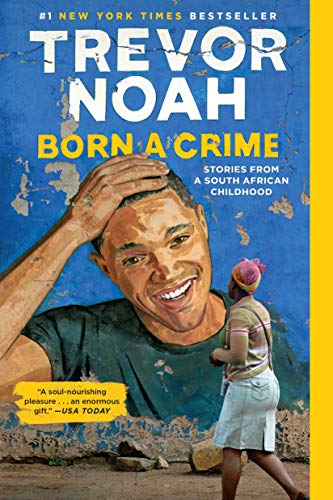
Image result for cover born a crimeI've just started listening to Trevor Noah's Born a Crime on audio, which is read by him. It's a book that's been on my radar for a long time -- well, since the middle of last year when a very bright and capable Somali young man came into my classroom carrying it, ready to read it for independent reading.


Sidenote about moments like this. It is difficult to watch high school boys (and girls, but generally it's easier to connect girls with literature they like) try out books that are the right kind of story, the right tone, the right content, the right kind of author, for them, but they don't speak English well enough for the story to float. This is what happened with R. and Ta-Nahisi Coates' Between the World and Me and with A. and Born a Crime. They are 100% ready to read this content, but don't have the reading skills in English. Maybe they don't have the reading skills in their own language either - they simply haven't been reading long enough to be prepared for text at their emotional maturity level. Listening to Noah's anecdotes, there are not that many turns of phrase and difficult vocabulary words, but there are definitely enough to throw off a new reader.

I just finished the chapter where Noah describes how he grew up in a world of women. Women ran the household the town, his life, his school... and he came to respect their leadership and authority. He also says this was no accident - that young, black South Africans were systematically separated from their fathers, who left to work in factories or mines, and in service jobs for white South Africans.

By the end of the first chapter Noah had proven himself a talented storyteller. He combines the poignant with the humorous to great effect - we are drawn in by his story, and educated by his details about Apartheid South Africa.

He describes his mother in remarkable terms - a woman who persisted in pursuing the things she wanted, despite many arrests and the constant threat of violence and death. One of his earliest anecdotes (the word "anecdote" hardly seems to have the capacity to hold this story's significance) describes how she shoved him out of a moving renegade taxi whose driver had implied that he meant to kill her and her children. Noah was 9 years old, and he and his mother barrelled out of the moving minibus, along with a baby brother, protected by the mother's body, and ran like the dickens away from the drivers in hot pursuit.

This story reminded me of the stories of several of my students, which rarely featured fathers, but quite often featured mothers doing feats of remarkable bravery and resistance. I don't know what to make of it. How can I explain the seemingly superhuman courage and perseverance of mothers in desperate times? There must be research on this.

OK, I just found some. This Smithsonian Magazine article includes an interview with a researcher whose research has shown that mother rats are smarter in many ways than non-mother rats. Here's an excerpt which makes me think of Noah's story, and of the stories of my students, describing how their mothers faced daunting situations coolly and fearlessly.

Mothers are less stressed out when you put them in a stress-inducing situation. They don’t show as much fear. They are more efficient at foraging. They will find food, collect it quickly and get back. They are more aggressive at defending their offspring; if there is an intruder or any sort of threatening presence, moms will fight it more than non-mothers. A recent study showed that moms are better at recognizing emotions than others. Mothers are able to recognize hostility, disgust, fear or the types of emotions that would trigger some sort of danger to their offspring.
This paragraph also helps to explain the attitude of Sharon Rivers, mother of Tish rivers and advocate for Fonny Hunt, in If Beale Street Could Talk. This week we have looked at the scene in which Sharon goes to Puerto Rico to trace the woman who has accused Fonny of rape. Sharon needs to find her, befriend her, and convince her to return to New York and change her testimony in court. A monumental task.

Sharon, arriving in Puerto Rico.
But Sharon takes it on with grace and self-possession. How do women do this? Would a man take on that task? I feel most would not. I think part of a woman's genius is that she is not afraid of what failure will do to her image, or self-image. A certain familiarity with humiliation emboldens her to act despite the possibility of failure.

One of my main goals as a teacher is to reduce the perceived risk of failure in the classroom. Today a student tried to express a complicated idea in class, and had to backtrack several times to correct what she was saying. Two other students gave sighs and sounds of exasperation as she paused and restarted for the third time. I spoke to them about how having to pause and consider what you're saying is not a sign of failure, it's a sign that what you're piecing together is worth expressing, because it's complicated. I always wonder at the efficacy of such statements. Can kids process that? Could I have, at 17? Probably. But I could understand every word a teacher was saying.

This particular student, by the way, has a very impressive mother, and is herself on her way to fearless, inspiring womanhood. I am so lucky to get to spend my days with these students.

Sunday, May 5, 2019

Norma and Dido, strong women

Utah Opera's current production of Norma features a strong women. Not only does this pagan priestess of the Druids' war god interpret and deliver the military strategy to the Druid generals and waiting warriors, she rings the gong that sends men into battle!

Image result for utah opera norma
As the opera smokes towards a climax, it becomes clear that Norma is delivering war strategy based on her feelings towards her flame, a general in the attacking Roman army, and that she pays precious little attention to the war god. When she and Pollione are on good terms, peace reigns. When he ticks her off, "Roman blood shall run in the rivers". 

Bellini created this role at a time, 19th century, when Western Europe became newly interested in ancient societies like the Druids. The program notes tell us: "England and Wales experienced a new fascination with the Druids and ancient societies that held national and cultural pride." Many of these societies, it turns out, did have matriarchal power structures, although the Druids was not one. "The notion of a formidable sacred feminine figure supports an emerging 19th century belief that many pre-historic societies were, in fact, matriarchies." And what an intriguing idea that would have been for those societies. 

I liked the opera's drama between the priestess and her acolyte, Adalgisa. These two women have an interesting series of movements toward and away from intimacy with one another, which I felt very compelled by, since it was devoid of the rather pathetic romance that characterizes that same dance between the romantic leads of any opera. Between the women it was clear they wanted attachment and meaningful relationship, but didn't know when to trust, when to strike out boldly alone, when to rely on another. 

The other strong woman on my mind this weekend is Dido. One might assume she came to mind after Norma because both women fling themselves upon a flaming funeral pyre our of love for a warrior husband... but no, I hadn't made that connection at all until just a few moments ago. 
The story actually begins at Office Depot. When I went to Office Depot to get some printing done for school, the song "Clocks" by Coldplay came on. It had been a long, long time since I'd heard Coldplay. I resolved to listen to a lot of Coldplay this weekend (a resolution which I kept, at the peril of my phone battery yesterday and ability to call a Lyft to get home from the opera). 

Coldplay brings me back to high school, so this afternoon I decided to listen to another artist I listened to incessantly in high school - Dido. Particularly, the album "Life for Rent". 

In one song, "Don't Leave Home", the speaker speaks tenderly to a lover in a way that also sets off all kinds of red flags - this woman is a controller. 


Look at the chorus, where she promises: 

If you're cold I'll keep you warm
If you're low just hold on
Cause I will be your safety

But then in the last line, forebodingly counsels, 

Oh don't leave home

She knows her spell is potent immediately - that she has ensnared her prey right away: 

When I've been here for just one day
You'll already miss me if I go away
So close the blinds and shut the door
You won't need other friends anymore
Oh don't leave home, oh don't leave home

As the song goes she gets more candid about how she intends to use her power - it's as if she knows her object, by this point, couldn't extract themselves if they wanted to.

I arrived when you were weak
I'll make you weaker, like a child
Now all your love you give to me
When your heart is all I need
Oh don't leave home, oh don't leave home

The "quiet" of the last verse is haunting. The quiet of having shut every other person out of the object's life. Friends are gone, no one is there to witness and stop the "bad romance" as Lady Gaga (another powerful woman) would say.

Image result for dido life for rent album cover
Oh how quiet, quiet the world can be
When it's just you and little me
Everything is clear and everything is new
So you won't be leaving will you


The "little" before "me" is taunting-  as if you needn't be afraid of course, since I'm just this "little" thing ...that has now taken over your life. 

Strong women, Dido, Norma, and others, are frightening. Would the world really be better if women were in charge? Maybe after a while, once all the resentment of past ills done us were handled in some kind of massive, collective 12-step inspired process...

What happened on Saturday: Extended worship

Extended Worship came to Portland Friends this weekend. This is a traveling ministry started by two New England Yearly Meeting Friends inter...