Tuesday, June 26, 2018

Kindred minds and spirits

I love the experience of reading something or hearing something that expresses an idea the fragments of which have floated around in my own head without achieving the coherence or simplicity that someone else has taken the time to render. 

This happens frequently when I read Quaker writings.

Indeed, when I read fragments of George Fox and his contemporaries (mostly in his journal, and in the New England Yearly Meeting Faith and Practice) I was astonished to find many of the ideas of 17th century Friends to resonate with my millennial mentality.

On Sunday I attended a forum about the Salt Lake Sanctuary Network at the local Unitarian Church. The discussion attempted to place the Network's work in the context of the national Sanctuary network. The presenter drew heavily on ideas espoused by the American Friends Service Committee, in particular the idea of Sanctuary Everywhere. 

Image result for afsc sanctuary everywhereFrom the AFSC Website: 

"Sanctuary Everywhere is the simple idea that everyday people can work together to keep each other safe. Sanctuary can mean taking someone into a congregation to protect them from deportation, but more broadly, it's about the community coming together to protect targeted communities from state violence—including immigrants, people of color, Muslims and other targeted religious groups, or LGBTQ people. 
Join us to create safe, inclusive spaces; dismantle the school-to-prison-pipeline; and become more effective allies."

Essentially, SE is about showing up as a neighbor. I cannot very well provide sanctuary to those I don't know or know of. Knowing my community and its needs is an essential first step to being the Quakerly neighbor I need to be in order to realize God's kingdom on earth. And that's what this movement, and all of Quakerism, it seems to me, is about. How am I participating in this earthly kingdom so that it becomes the true kingdom of God? 

Another place I am finding a kindred mind and spirit is in Una, the protagonist of Ahab's Wife. We are quite different - her appetite for adventure and risk is far greater than mine - but I appreciate certain truths that she holds to be self-evident. 
At this point her husband (pre-Ahab) is sick in the mind, and knocks himself out. As she bathes his brow, she asks, 

"Would it be better if Kit were dead? How bitter the idea broke in my heart, like a bad, foul egg, the shell of that idea shattered and drained out gall. What world was this to let Kit's pain drive him to nonbeing? And yet there was peace, quiet, rest, in his countenance - as though he had got through to something better. 
I would not believe that. This world was our arena. This place was where we had to look for any happiness."

I agree with her. This is our arena, and this is where we are charged with generating joy, love, justice, in our lives. Una's father spoke of eternal life. Una doesn't feel in her core the need for it, and neither do I. 

In order to be a good neighbor in this earthly kingdom, it seems important to me to create strong relationships within community. The past few weeks I've been wondering about how to spend my community service hours in a way that puts relationships first, even before the service rendered. 

I currently spend every other Saturday afternoon in a non-denominational Bible study at the Utah State Prison, and while the activity and interaction with the inmates is I'm sure welcome on their end, the frequency and nature of the visits doesn't encourage true relationship building. I hardly know the guys who are there. 

I wonder how I might dedicate those hours to a more relationship-based form of community building. One thought that has surfaced many times is to chaperone a hiking group for students at Utah International Charter School, where I work. In the interest of strengthening current community bonds, rather than spreading myself out across more but flimsier connections, I like the idea of leaning into the UICS community in a way that would help me get to know the school's students in a non-academic context. 

And, it's far to easy to live next to the mountains here and never get into them; without the right shoes, car, skin color, and know-how, it can feel very uncomfortable to venture into the mountains on one's own. I remember living in Lourdes, France, and being so surprised that our elementary school students had never been into the Pyrenees. But the same phenomenon exists here, to be sure. 

I'll keep praying about this service possibility.

Monday, June 25, 2018

Moby Dick, compared to Ahab's Wife

Image result for ahab's wife coverAt the beginning of this month I read Moby Dick for the first time, and was underwhelmed. The book had such a promising beginning, and Ishmael's voice was so earnest and engaging, but the action of the book went almost no where, I found. Nothing was happening, and too much of Ishmael's precious energy was wasted on uninteresting descriptions and odes. 

Now, a third of the way through Ahab's Wife, by Sena Jeter-Naslund, I am starting to understand the author's motivation. She is taking the premise and the rich characters of MD and turning them into a page turner! I am enthralled in Una's world, as much because of the way she tells the story as its events. Whereas by the 50% mark I was skimming MD, skipping passages of descriptions and jumping to the dialogue, someone would have to pay me to skip pages in this book, where I can hardly tear my eyes away from the page to attend to the (precious few, blessedly) other things I need to be doing this week. 
How much of the increased interest lies in the fact that Una is a woman, and tells the story from a female perspective, contrasting with Ishmael's young man? Some, I suppose. But I think this book would be just as good if it were Ahab's Brother. 

Sunday, June 3, 2018

Sunday Messages

This post's first thread of experience, soon to be woven in with another: Today I visited the Young Single Adult (YSA) ward that a colleague attends. While there is lots of sharing of personal messages, or testimonies, at LDS meetings, there is not a sermon or specific take-home message, so this afternoon I still felt as though I was in need of a Sunday Sermon.

Image result for guess who's coming to dinner posterSecond thread: Last night I watched Guess Who's Coming to Dinner for the first time; or rather I watched most of it. By 10:20 I felt like I knew how it was going to end, and was no longer interested. I was also distressed by the way the movie was treating race. The main character Joey falls in love with a black man 14 years her senior while on holiday in Hawaii. Both are smitten, and decide to get married.
They return to San Francisco, to Joey's parents' house, and break the news of their shocking engagement. The parents struggle theatrically with the race of Doctor Prentice. The black man is exceptionally accomplished, but he's black. Sidney Poitier plays the good Doctor, who keeps apologizing for being "the problem" in what I found to be the most unrealistic and unconvincing portrayal of a black fiance.

After viewing, and especially upon waking up, I wanted to know what James Baldwin would say about the film. I remembered that Poitier had been mentioned in I am Not Your Negro, and wanted to read more about Baldwin's impressions of white cinema's use of this black man.

He wrote a book-length essay, it turns out, called "The Devil Finds Work" about race and cinema, including comments on Poitier's career. I couldn't find it in PDF form, so I've requested it from the library.

In lieu of reading that document, I found a youtube audiobook of The Fire Next Time, my favorite Baldwin text, and have been listening to it while I've made this tomato fennel soup, which is now my favorite tomato soup recipe, probably because of the quantity of butter into which the onion and fennel are melted in the first stage.

Fire has much to say on themes that Guess Who's Coming brings up. For example, John, the Doctor, is portrayed as someone who seeks acceptance into white society, and seeks to be called "successful" along the lines white people have established. This is what Baldwin has to say:

"There appears to be a vast amount of confusion on this point, but I do not know many Negroes who are eager to be 'accepted' by white people, still less to be loved by them; they, the blacks, simply don't wish to be beaten over the head by the whites every instant of our brief passage on this planet."

In the letter to his nephew which opens the novel, Baldwin is more pointed:

"There is no reason for you to try to become like white people and there is no basis whatever for their assumption that they must accept you. The really terrible thing, old buddy, is that you must accept them. And I mean that very seriously. You must accept them and accept them with love."

This is not what Guess Who's Coming implies needs to happen. The whole plot is predicated on the idea that the white world needs to accept John, even though it would be perfectly reasonable to say "that's just too much to ask!" as Joey's father does for most of the film. John, sadly, is as convinced of this as the rest of the cast.

Which alludes to another of Baldwin's points: the crime of this country is that it teaches the black man that he is depraved. In that same letter to his nephew, he writes "You can only be destroyed by believing that you really are what the white world calls a nigger."
A few pages later:

"This innocent country set you down in a ghetto in which, in fact, it intended that you should perish...
You were born where you were born and faced the future that you faced because you were born black and for no other reason...
You were born into a society which spelled out with brutal clarity, and in as many ways as possible, that you were a worthless human being."

In Guess, the cook/maid, a woman of color, is furious at John for attempting to rise above his station. She has fully internalized the low expectations that the country laid before her. Even though he has exceeded those expectations, John seems to have internalized the same inferiority complex. 

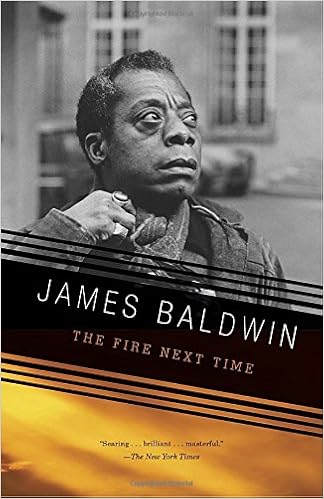
Image result for the fire next time coverJoanna says that she doesn't see what difference race will make. John says she loves him because she doesn't see a difference between him and herself. This is just naivete, to think that black people and white people inhabit the same world in America (especially in 1967, but also today). Again, Baldwin speaks to this: 

Now, my dear namesake, these innocent and well-meaning people, your countrymen, have caused you to be born under conditions not very far removed from those described for us by Charles Dickens in the London of more than a hundred years ago. (I hear the chorus of the innocents screaming, "No! This is not true! How bitter you are!" -- but I am writing this letter to you, to try to tell you something about how to handle them, for most of them do not yet really know that you exist."

The last line, "most of them do not yet really know that you exist," describes exactly what I see happening in the movie. Joey doesn't really see John. Neither do her parents. They also don't see their maid. I'm not sure what they're seeing. But it is not the full human.

When I turned to James Baldwin looking for a more exacting and demanding lesson than I got at church this morning, I turned to the right place. Listen to this last though, given in the part of the book where Baldwin describes his own introduction to Christianity: 

As he grew up and learned more about the way things worked, it became clear that "Neither civilized reason nor Christian love would cause any of those people to treat you as they presumably wanted to be treated; only the fear of your power to retaliate would cause them to do that." Here is the crux of the violence issue: Did white America respect the black man as he was? No, and the lesson for this young Baldwin was that unless he had a lever, a trigger, he would not be treated as these Christians themselves wanted to be treated. 

Violence seemed the only answer. In the Judges text we looked at in Sunday School today, violence also seemed to be the only answer. War, my friend pointed out, was an act of preservation. Even as a Quaker I see the appeal and necessity of violence in some areas. Pacifism seems untenable when one side is so intransigently obtuse or abusive, or both. But look at how Baldwin responded to injustice: Writing unbelievably eloquent and love-based books for the American public, whom he must have believed deserved another, and another, chance. That is an act of love.

What happened on Saturday: Extended worship

Extended Worship came to Portland Friends this weekend. This is a traveling ministry started by two New England Yearly Meeting Friends inter...