Sunday, July 29, 2018

Poem

A poem in this week's issue of the New Yorker speaks to this week's experience.

Seraphim, by Patricia Spears Jones

Once a beauty, full figured, beloved
And then a fever, sweats, water vomited
Until the body gave out. And then,

Wings and lyres and legion of other
Angels. Singing, dancing, flying about,

But once a beauty remembers
Physical love and then its loss

Eternal life seems mundane
No conflict or need or desire.

Thus, this seraphim held melancholy
Gentle as a lull in a long conversation

But heaven allows only jubilance.
Possibly the angel needed to return

Human: with feelings, tears and laughter
Or find a way to shape the sadness into
A moment of beauty when the angel's wings

Spread and flight moves to breathing
Full of vision. There an angel's tears bond
with the visitor's fear, awe. It could be

a filmmaker's perambulating Berlin,
in search of a reason to consider
the spirit, those angels set on top of monuments
across the handsome city.

And they love the lovers.
And one remains lovingly disinterested.

How dreams and death and a dearth
Of joy is visible. And wings spread
And wings fall. And the beloved becomes
A man who understands a woman's
Full figure. A man who fears fever.
A man who takes his lover in all
Her melancholy and lifts her up

And unto joy.

-------------------------------------

Much of the Sufi and pre-Islamic poetry we have looked at these weeks has shown the connection between divine and physical, human love. Our love, lust even, for another human is a yearning for the divine, from which we have been separated.

This poem gets at the same idea from another angle, it seems to me. The angel, granted paradise after a bout with fatal illness, yearns for the trials and tribulations of human love: the tears, the conflict, the desire. Life in paradise is Mundane without the elements of earthly love that the sufis write about, that painful ecstasy and intoxication that makes the sufi feel most alive, it seems.

Yesterday at the Met a few other scholars and I looked for a while at the Renaissance and classical Greek sculptures. We decided the women and men are sexualized to the same degree, but the men's sexuality (we were looking at Perseus) is glorified, while the woman's sexuality is used against her, as a tool to make her seem weak, or objectified.

I like that at the end of this poem, the man appreciates his lover's full figure, as if his eye encompasses all that she is, not just the sexualized nature, and exalts her whole being "unto joy".

Wednesday, July 25, 2018

Day 9: Concert, and Day 10: The Met

This is Sahar, the fearless leader of this institute, introducing the performers at last night's concert of Persian and Turkish music. The event was held at Poet's House, the largest poetry library in the world (or at least Sahar said with some conviction).


Here are some of the other teachers at the concert, on the rocks. The performers read Sufi poetry by Rumi and Hafez, and then played the musical versions of those poems. I felt nostalgic for Palestine listening to the oud. 

This is the parlor at the Penington Friends House
where guests and residents are free to hang. I've
been writing there each humid morning.

The humidity here is kind of out of control. I feel at every moment as though I've just climbed out of a steamy shower. 

Most of the artwork I saw today knows nothing of humidity, existing as it does in the Met's highly climate controlled rooms. Many of the rooms I entered today I have never been to in the visits I've had there; mostly the arts of the medieval period from lands of the Middle East and Central Asia. 

It was an incredible day. I loved seeing especially the small pieces that were in daily use by the people who practiced the kind of Islam, and read the kind of poetry, we are reading. Here are a few things I have comments about, from the Islamic galleries and others: 


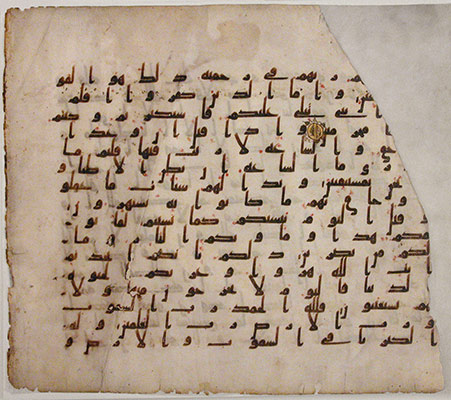
Qur'an on a stand

Fantastic throne leg with some terrifying monster coming out of it. Reminded me of the "Medieval Monsters" exhibit I saw last week at the Morgan, which explored how monsters are oft invoked by religious or royal folks to show their power. "Don't mess with me," the message seems to be, "I've got this guy only a phone call away."

The daily use (though surely for the elite) objects were unbelievably beautiful.

This was all different kinds of inlaid stone, wood, and other colored materials.

I asked a docent where I could get away from the crowds, and she sent me to the East Asian galleries. She was right!

This little cabinet in the "Art of Tibet" gallery bespeaks a different attitude toward death in this particular Buddhist society: it is decorated with skulls and skeletons,
and along the iron hinges and reinforcements are "heads at different stages of decomposition." 

Just loved this little guy, begging joyfully?

Small icons of the sort that would live in homes are of interest to me. 

A temporary exhibit on Japanese painting. These screens were huge and magnificent.


Sunday, July 22, 2018

Days 6 and 7 (Weekend)

Our group hopped on Metro North to go to the Untermyer Gardens today, a gem in Yonkers, available free to the public. They were created by a wealthy American who had traveled in the east (sorry I wasn't really listening to the lecture - too distracted by the walls, fountains, and views.)


So that was Saturday. 

On Sunday I went to the very silent 15th Street Meeting (they said after the 9:30 service that the 11 am service usually has more vocal ministry). A beautiful space which was really too big for Quaker Meetings now. I don't like being so far away from others in the space. It makes vocal ministry seem almost impossible - especially when there are a dozen fans trying (in vain) to overcome the 95% humidity outside and inside.

Still an important hour of worship, as it always is.


This afternoon I got to sing with a friend along the East River. It was nice to sing again, especially as a reprise to the magnificent time singing I had with friends in East Greenville, PA last weekend. A few minutes later, on my way to the Guggenheim (where the crazy crowds sent me running for Central Park - I'll figure out how to get back during the week. I was silly to think a rainy Sunday afternoon was going to be a good time...) I passed this poster stuck on a random building and appreciated this Lutheran endorsement for all my singing: 

Day 5

This morning Dr. Kemal Silay gave a fascinating lecture on Turkey's political situation and on the change in its poetry over the past several years. The overall gist was that Islamists today say they are getting back to the good old Islam, and cite tradition when they crack down on women and on gays. Dr. Silay used analysis of the kind of poetry written during the middle ages and under the Ottoman empire to point out that society in those days was far, far more lenient, diverse and welcoming than what the Islamists are pushing for now.

People in power the world over seem to be in the business of denying their countries' pasts. The leaders of Turkey, including Erdogan, whom Dr. Silay classed as a dictator, deny that Islam has ever been inclusive or diverse. The poets tell a different story.

Mihri Hatun, (1461-1506) wrote about the real beauty that women possess, not the beauty that the male poets of her time exalted.

Image result for ottoman empire mapThe poet Nabi (1641-1712) calls for poetry that is not empty, but says something substantive. "Don't draw up your nets empty from the sea" he enjoined his peers.

Poetry during the Ottoman period even speaks about women with blue eyes, because the Ottoman leaders often married Russian women.

Current Islamists look back at this tradition and "have a fit" says Dr. Silay. They deny the life and zest of early Turkish poetry.

Here is a ghazal by a contemporary Turkish poet, Ataol BEHRAMOĞLU
GAZEL TO A NEW LOVE
I come to you crossing abysses
Crazy, flying I come to you


Forgetting what so often ended in grief
Oh so avidly I come to you


Full to overflowing with songs
Tongue-tied I come to you


My mind more jumbled than the bazaar
My heart all topsy-turvy I come to you


To learn everything all over again
To forget what I know, I come to you


Just like one newly come into the world
Stark naked and wailing I come to you


Saying, pluck me up again by the roots
So you’d set me flying, oh love, I come to you

Day 4

During this first week I observed that the women brought in to teach us taught differently than the men.

Bushra Rehman was the first to ask students to read things from the board. She was the first to create an activity that was a true workshop where we worked with each other and created our own poetry-in-translation. Her class was the one that had us all literally buzzing with excitement about what we had created - that's the feeling I want to create in my own classes!

Frances Pritchett
Dr Pritchett
Today, Dr. Frances Pritchett followed in this model by also asking us to read the poetry projected on the board, rather than reading it herself, as all the men teachers have. She also turns the traditional teacher's advantage on its head by maintaining a remarkable website about Persian poetry.
At the beginning of her talk she said "My lecture is not going to be like the others you've been experiencing, because unlike the other lecturers I'm not trying to get you to understand every possible important thing about an area of study that I've spent decades in. That's not my goal."

She went on to explain how in her retirement, her goal has been to create resources for all the material she knows about and taught, on her website dedicated to Urdu Poetry. It is a remarkable feat. There is everything anyone would ever want to know about Persian Poetry on this site, and she maintains and updates it all herself.

Today's study of the ghazal genre also touched on the idea that romantic passion is divine in nature. It is also, interestingly, transgressive. The poet, or rather the speaker, is always transgressing in some way. So, for example, the lover in the poetry is not the poet's wife (!) or the person he is destined to marry. It is a woman or a boy who is not available.

Transgression has been so stamped out of religion - it is about conforming rather than challenging. I suppose some Christians, Quakers included, see their role as challenging power, but so little of that challenge happens at the Meeting level, or the congregational level. We are by and large very well behaved. I say this as a criticism of myself. I think I could certainly be more transgressive with my political voice. Jesus certainly was.

Another thing Dr. Pritchett pointed out about the ghazals that I liked was that because they were so formally constraining, they really allowed a poet to show his or her stuff. When there are no rules, it's hard to say that something is not good. But when there are so many constraints, you really have to know your vocabulary and your poetic tone to succeed.

I also like that in the poetry gatherings, people held their friends accountable - they might say something like "You're not using that idiom right" or "Your rhyme is not as tight there as in the rest of the poem." This kind of criticism is unusual in most writerly circles I know because we are all too friendly. We have to pay an editor big bucks to be mean! I like the idea that friends would value their friends' abilities well enough to push them. I want to do this with students- to warmly demand their best work by pointing out where they have fallen short of what they can produce.

==========================

Did you know that Langston Hughes went to Turkestan?

Image result for langston hughes in turkestan
Hughes with a writer's group in Central Asia
Zohra Saed, our presenter this afternoon, had put together a slideshow of images from Hughes travels in the USSR in 1932-33. It was pretty remarkable. Apparently Harlem was a point where Soviets recruited communist sympathizers to come to the USSR and see how life could be. Hughes went on one of these trips, but he didn't stay on the mainline tour, which of course skimmed over the difficult truths of communism and looked only at a handful of propped up scenes of happy and productive Soviets.

Hughes literally jumped off a train as it went south and visited the southern bloc countries where he photographed working conditions on the cotton farms (which bore striking resemblance, of course, to cotton plantations of the American south). 

Thursday, July 19, 2018

Day 3

A quick post! Last night was a late night so I didn't write anything, but mash Allah my mind is exploding with how amazing class was yesterday. 

Poetry. Specifically, Sufi poetry of Rumi and Hafez. 

I have been exposed to Rumi's poetry and that of other sufis many times, but never has it really stuck. I don't really get the mysticism, I am not compelled by the imagery of love and wine. It all feels rather pithy and overblown, like so many of the romantic poets I read last year at Bread Loaf. 

Image result for cup bearer sufi poetryThe form of sufi poetry we looked at was the GHAZAL (pronounced ga-ZAHL).  It is the most prolific form of Persian poetry, and predates Islam, dating to the 6th century. 
One issue that came up for me right away was the question facing faithful seekers and humanists across the ages and cultures: how much do I remain "of the world" and how much do I attempt to be removed from it, being only physically "in the world"? Most sufis seek self-annihilation, so they desire to be not even "in the world" physically. One early Sufi poet, a woman named Rabi'a, said that LOVE was key to an understanding of God, so experiencing love and giving love (activities arguably "of this world") were key to spiritual experience. I like that. 

So I was surprised to know that Sufism was the mainstream form of Islam until the 19th century. Yes! What happened? Why is the Islam we know politicized today? Because of Colonization. When lands where Muslims lived became overrun by colonizers, leaders of these lands decided that Sufism was not the tool they needed to fight the invaders with. It was too escapist, too soft, and made people too dependent on one another, rather than independent and ready to work hard, as the new modern world required them to. These leaders recognized that if Muslim-led countries would be able to compete with colonizers and colonized countries, they would need a style of governance more appropriate for capitalist battles. So Suffism was swatted down, and politicized Islam arose in its place. 

The wine imagery: Why is there so much drinking in poems by Muslims, who are instructed not to drink? 

Simplest answer: The wine is symbolic of otherworldly intoxication that one experiences when one approaches the divine. 

Interestingly, the cub-bearer figure, present in many ghazals, is often a young boy, and is portrayed both as a master, and the provider of the intoxicating experience. Homoeroticism is a strong strain in these portrayals. Why do we think that homosexual relations are a new thing?

Ghazals were written to be performed. This is where my lesson-planning funny bone started to twitch. Last year we had Poetry Out Loud in which students memorize poems by outside authors (whom we haven't studied, and they don't necessarily know what the poems are saying). The kids were not into it, and many failed to memorize their poems, even though I know them to be fans of poetry and great poets themselves. I'm wondering how to redo poetry this year (Poetry Out Loud is a school wide, required thing, not my choice) to make it more personal and engaging for them. I think we're going to write ghazals. 

Just this morning I read about the venue in which poems are shared, the mushairah. Check out this description of the event: 

Image result for mushaira image
A real Mushairah in India
Most mushairahs were based on a well-known ‘pattern’ line (or verse) announced in advance, so that everybody’s ghazals composed in this pattern were formally identical (sharing meter, rhyme, and refrain). This formal identity made them extremely comparable, so that individual achievement stood out strikingly. Recitation-- or chanting in a popular style called tarannum (an example: Jigar Moradabadi, 1957)-- of the first line of a verse was followed by a longish pause full of obligatory praise and exclamatory comment from the audience, after which the poet repeated the first line and only then followed it with the second line. Mushairahs were thus lively and participatory.

OK, I'll have to come back to this post, or do a poetry part II post, because there is so much more to say. 

Tuesday, July 17, 2018

Day 2

It rained hard this afternoon, and I arrived home quite wet. My Composition notebook is several stages closer to Decomposition, but I have less to recount than I did yesterday, because a) a chunk of today I didn't really understand or feel engaged by and b) in the afternoon session we did calligraphy for about an hour, so I have no notes, but a painting.
Me and two other scholars before our visit to the Mosque yesterday


This morning Muhsin al Musawi of Columbia University spoke to us of Sufi poetry. There were several interesting ideas. Principally in relation to love. If one reads sufi poetry, it is easy to think that the Sufis were obsessed with drinking and romantic love. But the drink is really only alluding to the intoxication that Sufis seek by communing with god. Their wine, as Musawi said, is not our wine. 

Related image
I think this image gets at the subsumption
 into the divine.
The goal of Sufism is to be in fact subsumed into the divine, to become one with it. This involves the entire annihilation of the self. Like a moth that is drawn to flame and finally dies when it comes in contact with the heat, a sufi seeks to be burned by her proximity to the divine. The goal is to lose oneself in the mystical experience that is divinity.

The erotic love between the poets and the young women they often write about is also divine in nature: the beauty that the sufi poets are attracted to in these women is really God, manifesting in them. I suppose this could be construed as something similar to the Quaker light of the divine within, though thankfully the Quakers don't have any conceptions of physical beauty as an indication of inner divinity! 

But I must confess that whatever puritan streak remains in my upbringing makes me raise my eye brows at the alleged reverence motivating these poets. It seems like an easy way to justify lustful feelings while still considering oneself holy. (Here's an article from the NY that I read a few years ago about St. Augustine's brain child, original sin.)

But then, what is wrong with lust? It is only because of that Puritan streak, indeed, that I have the idea that erotic love is bad, or impure. What if our culture glorified even romantic love as one of the highest attainments, something natural, or more radically, divine in nature? I don't think Las Vegas would exist in that culture. We would not have the deep ambivalence and shame that results in such an outburst of incoherent and violent energy.

All the yearning that is done in sufi poetry is really yearning for God, because God is what we are attracted to in another person, or a place or thing. This was argued (either initially or most powerfully, I'm not sure) by Ibn Arabi, a poet born 1165.

I had forgotten about this Bible (and surely Qur'an) story, which al Musawi told to illustrate the Sufi desire to be annihilated in communion with God: 
Image result for moses and the mountain breaks before godMoses is aware that his people don't believe, and he desires to offer them reassurance. He says to God, "Please, show yourself to me, so I can report to my people that I've seen you." God says, "If I show myself to you, you'll die. I'll show myself to that mountain, and you stay where you are and watch." God shows himself to the mountain and the mountain trembles and then breaks apart and disintegrates. Moses faints.

Isn't that great? Gotta love the Old Testament.

What about modern poets? Well, they don't have the courage to wish for self annihilation through communion with God (my words, not his). (By the way, I don't have the courage either). Modern poets believe in the visionary quality of poetic work, but are not about to self-abnegate through it; in fact they don't think it's possible to achieve that. 

They should talk to the guy who was martyred by being gradually dismembered, laughing the whole way, because he had no consciousness of his body as physical. He was entirely one with the divine. 

Image result for el seed calligraffiti
eL Seed Calligraffiti
This afternoon we had a calligraphy workshop. We saw several of the scripts used in advanced calligraphy. Many were very hard to decipher, even for a reader of Arabic or Farsi or Urdu. It seemed that the emphasis was so clearly on the visual quality of the art, not just the meaning of the words conveyed. Imagine an English poetry volume in which the words can't be made out! Simply the depiction on the page carries enough significance of the beauty of the words.

Image result for alone aka tanha calligraffiti
A1one aka Tanha
The presenter also showed us calligrafitti images from A1one aka Tanha and eL Seed, images that are unreadable but use letters as basic units.

I missed Utah a lot today, so my image depicts the mountains:

Monday, July 16, 2018

Reverence for Words Day 1

It's 8:00 pm in New York, and I'm in a Starbucks on Union Square (I say "a" because there are multiple on the park.)

I am now one day into the National Endowment for the Humanities (NEH) workshop called "A Reverence for Words: Muslim Cultures through the Arts".

Today I spoke with a few other scholars about the need to take some kind of productive action to preserve what I take in during the day. Indeed there is so much intake, I need a way to process it, even if at a basic level, to solidify some of it in my mind. Since I don't have a dog to tell these things to out loud (that must be why people have dogs - to rehash their learning outcomes from the day) I will quickly treat them here.

This morning Dr. Shawkat Toorawa of Yale University spoke to us of the Qur'an's influence on literature.
Image result for qur'an image
First he spoke to us about the key terms for understanding the religion.
Islam (don't pronounce the s like a z) is the religion.
Islamic is a problematic word which we should basically never use. It's an adjective, but it's unclear whether it describes something/one of the religion, or of a country which is majority muslim, or under Muslim leaders...

He drew a parallel between the absurdity of the idea of a monolithic Christian world and a monolithic Islamic world. The "Christian world," he pointed out, would have to include Nigeria and South Korea, because each has made significant contributions to Christianity. But they are, of course, not part of the same world in the cultural, linguistic, historical, or ethnic sense. The same is true for Muslims the world over.

An Islamist is a muslim extremist. An islamicist is a scholar who studies Islam.

This was so cool: The Qur'an is not a book! The Qur'an is the revelation of God's word, and as such cannot be destroyed or damaged. It is also not truly possessed in the book (the book itself is actually called the mus-haf, or a copy of the revelation) but in the mind, where one is supposed to have it committed to memory.

This made me think of the notorious George Fox song, and how he refuses to swear on the Bible, "For the truth is more holy than the book to me!" Indeed, the Qur'an is the truth of what God said, and is contained in the heart.

Another cool thing about the Qur'an: It is not the story, or narrative, of a people, like the Hebrew Bible is for the people of Israel. It is a book of admonition, which basically tells stories to illustrate what happens to people who do not do as Allah says.

The Hadith, on the other hand, tell us all about how to live our daily lives.

The Qur'an was revealed over 23 years (each revelation was through the Angel Gabriel), and during that time Mohammad received little bits and pieces of it. And that is how it existed in the minds of believers, as little memorized bytes, each relating to an idea or telling a story. These bits are suras.

The professor spoke quite a bit on the misguided idea that many have now that the Qur'an was an inviolate text which no one could use for inspiration or appropriate parts of for their own artistic purposes. In fact, this is what people have been doing for ever, and it has been seen by the most devout as a way to lift up the Qur'an by showing its place of pre-eminence in daily life and thought. I love this idea. When I teach Shakespeare, which is also rhyming and poetic, bits of it get stuck in my mind and I appropriate them for my own purposes. For example, this fall when I teach Othello and someone calls my name across the room, I might just make use of the phrase "I shall be with thee betimes" because it's relevant and I like the way it sounds.

Just such borrowing has been integral to Muslim daily thought life, says Dr. Toorawa. There were indeed Muslim wits who would use bits of the Qur'an to make people laugh. Copies of the revelation (Mus-haf) were also heavily annotated with notes to self and exclamations etc. I plan to show students some of the pages of annotated Qur'an to show them what annotation looks like, and how it's used in different kinds of reading.

                   A note on the Arabic language: its grammar and lexicography developed very quickly, because once Islam started to spread, people really wanted to know what the Qur'an meant. They needed to do their own figuring out, and so the language developed to help them decipher the holy text.
Related image
See - no vowel marks (the dashes and lines under and
over arabic script that are absent here)
ALSO COOL: Written verses of the Qur'an were almost impossible to decipher to readers unfamiliar with the text. The words, printed without vowels, were strictly a nemonic device: it was assumed that anyone would already know the words from having memorized it, so this page was just there to jog one's memory.

Last note on Toorawa's lecture: Islam defined itself to an extent against Christianity and Judaism as a religion which did away with the hierarchy necessary to communicate with God. Someone could recite the Qur'an (as our afternoon lecture said, in order to ingest divinity, rather in the same manner of the eucharist) and know God through God's word. No intermediary was necessary - people were meant to commune with Allah themselves.

This makes sense given the emphasis on prayer to Allah. We visited the second largest mosque in NY, at the Islamic Cultural Center of New York, where we were reminded that men and women pray separately. The Imam told us in admirably frank terms that this is to prevent distraction, especially for the men, from Allah, who should have their own focus. This is fine, although I think this repeated separation, especially when men are positioned in front of women, simply makes the men accustomed to being ahead of the women and in a better position than them, in the name of "reducing distractions".

Someone asked a great question at the end of Toorawa's talk: what role does Jesus play in the Qur'an and in the faith?

Image result for jesus and muhammadHere is a partial comment on what he said: Jesus is the prophet before Mohammad. In the Qur'an he does all the miracles attributed to him in the Bible. He is born of a virgin, he raises the dead, walks on water. He is even resurrected (though not crucified). It is as if the point is: this prophet was so so so amazing and still people disbelieved! Even his ministry didn't work on this world! So Mohammad came all those years later, and basically said "Here's a summary of everything the other prophets have told you, plus this: This is your last chance." Shape up. Account for your lives before someone else accounts for your lives on Judgment Day.

Toorawa added that prophets also become increasingly fatherless. At first the link is clear: Adam is like God's son. The sons of Adam are humankind. Then things get harder with Abraham, who is asked to repudiate his father, and repudiates his son Isaac. This is hard to do - it's the hardest thing to repudiate one's father for the sake of something greater: God. Jesus doesn't have the same problem with this, because he doesn't have a father, and he doesn't have sons. So that's another way Jesus is more magical, or miraculous, or God-like than the others - this lack of father hang-up.

That's basically the end of today, except that in the afternoon we had a lecture on how Allah Is Beautiful and Loves Beauty. The lecturer was Zain Abdullah of Temple University. The point he made that I liked, even though it's very simple, is that most Muslims don't speak Arabic (only 15% are arab) so it's not the meaning of the Qur'an which keeps them coming back. It's the beauty. There is something about the religion which appeals to our delight in beauty, and that is the glue that keeps one in the faith.

I think this is true for me of Quakerism too. I find the silence beautiful. The model of community beautiful. The simplicity beautiful. Even when considered with the difficult and frustrating parts of Quaker practice, there is an overarching to the ideals and practice of the religion which bind me to it.

Image result for sin of prideA word on Pride

Today the idea of Pride was mentioned several times as being the root of all sin. Abdullah elucidated that Pride of appearance is not the issue, in itself. It's not bad to want to look nice and have polished shoes and pressed shirts. It's bad to do two things:
1. look down on others2. knowingly ignore the truth

Therefore in order to be humble, we must see ourselves as equal with others, joined in the chorus of singers, shoulder to shoulder, and we must look the truth in the face and act according to what Allah demands of us once we are aware of the truth. That's all!


Sunday, July 1, 2018

Quaker Meeting today, and Una, the Star-Gazer

Today I returned to the Murray Quaker Meeting. I walked into a far more crowded Meeting room than I had ever seen. "How time has wrought change here!" I thought, and wondered how many were visitors. 

Image result for quaker meetinghouse murray utThe Meeting for worship was good. I had been nervous to go. I journaled about the nervousness. 
1. Part of it stemmed from the fact that I hadn't seen these Friends for months, and hadn't communicated about why I hadn't been at Meeting. I felt embarrassed. But this hangup seemed only part of the issue, since I knew in my heart of hearts that everyone would simply say "Good to see you!", which they did. 

2. I kept writing, and wrote this sentence: "I am afraid to go to Quaker Meeting because I can't pretend to be perfect there." It's true that in most church services, it's pretty easy for me to come off as doing perfectly fine. I can sing, I can read along with a prayer, I can listen to an intelligent sermon and understand it. I can make enjoyable conversation with friends and new acquaintances at coffee hour. 

At Quaker Meeting, two things threaten this mirage. The first is the silence. I cannot pretend for an hour of silence in communion with others that I am doing enough to align my life with God's will for me. That idea is untenable after just a few minutes of silence, and certainly dissolves after the first instance of vocal ministry. 

Today's ministry brought up such discomfiting subjects as "the seeds of hate" and "power and control - who do I want to control? How can I stand up for those who are being controlled by abusers?" These questions probe deep, and unlike sermons, don't portend to offer solutions or conclusions. These questions linger in the mind and heart all week if not longer. The silence threatens my own perception of my perfection. 

The second thing that threatens the mirage is the form of community in Quaker Meetings. It's on us. There is no paid staff to make new people welcome, or to talk to people about what's going on in their lives. We embark on the joyous and unpredictable errand of living in community at the end of the silence. We figure out, together, how to live with those among us that maybe we don't like, or who don't live the way we live. 

Once I had enumerated both of these aspects of Quaker Meeting as being the seat of my discomfort, I closed my journal, jumped into the car, and drove with alacrity toward the Meeting house. These very things were the hallmarks of the kind of religious community I wanted to be a part of. Suddenly I was eager to lean into the discomfort they engendered. 

I was not the only one led to the Meetinghouse this morning. During the introductions round three groups of people said it was their first time to Quaker worship and that they were navigating "faith transitions" and looking for genuine faith communities where they could feel as though they had something to offer. 

It was also a joy to fall back into conversation with (F)riends who I discovered this morning were more dear than I'd realized when I left in January. I heard wonderful accounts of Intermountain Yearly Meetings annual sessions in Ghost Ranch, NM, and am already eager to claim my own place there next year. 

Image result for nantucket 1850Ahab's Wife continues to minister to my spirit with each chapter. Una's spiritual journey includes many turns which my mind's eye has contemplated, even if my mind's feet have not trod it. She seems to me the best kind of Quaker, untethered by the thinking of her time, and ready to let her own experience inform her understanding of the divine and of the world. 

Here she takes on both "that of God in everyone" (the inner life) and the silliness of our concept of marriage. 

"And suppose the universe itself is but some greater globe where it is possible to travel through rather than on its curving surface. Or suppose that - that we are only on the surface of a dark expanding globe - then where is the journey to the place that is limitless? I find it within. Last night I found it within me - independent and single. No, I do not unmarry Ahab. But I marry myself. I take my fate as within."

She, a woman who is not afraid of love, and who gives her own love without fear of hurt or rejection, finds that her spiritual journey is independent. No matter how a woman is wed to a man, and she and Ahab are wed in what seems indeed a divinely ordained sense, she is still her own being as far as her spiritual journey is concerned. 

One aspect of Una I found impressive was her resilience and adaptability. I was surprised, late in the novel, to hear that she considered this a potential fault in herself. Her opinion becomes clear in a conversation that starts with her characteristic deviations into childishly grand statements, which I found endearing and the sign of a confident woman, not afraid to say what was on her mind.

"When we were all dry and changed and the boys had gone outside to play, Mary and I sat beside the hearth and chatted. I felt wonderfully fresh and happy. 'Sconset, I told Mary, was far better in its simple isolation than town with its bustle. I had never lived in a town before Nantucket, and, I claimed, if I had more people about me th an could compose the crew of a ship (about thirty on a whaler), then I grew restless. 

Image result for view from siasconset
View from Siasconset ('Sconset)
'No, Una,' she said, 'you are a person who can adjust to anything. If you prefer 'Sconset, it is only that you choose it.'

Always, I have felt uncomfortable with such a remark - it implies I have no true core, no essence - but I knew Mary did not mean to imply that I was lacking She must have seen the shadow pass over my face, for she reached out and took my hand.
'I meant only that you are always your own true self. Every time I see you I am but more impressed by that.'"

To have friends like Mary! Who can speak so simply and well about a friend's character. I agree with her - Una's strength is that she is herself in every setting. That self is not consistent through the book - do we not all change as we journey? - but it is always genuine. 

Nothing could be a proper coda to the splendor of this book. So I'm going to reread Pride and Prejudice next. 


What happened on Saturday: Extended worship

Extended Worship came to Portland Friends this weekend. This is a traveling ministry started by two New England Yearly Meeting Friends inter...