It's 8:00 pm in New York, and I'm in a Starbucks on Union Square (I say "a" because there are multiple on the park.)
I am now one day into the National Endowment for the Humanities (NEH) workshop called "A Reverence for Words: Muslim Cultures through the Arts".
Today I spoke with a few other scholars about the need to take some kind of productive action to preserve what I take in during the day. Indeed there is so much intake, I need a way to process it, even if at a basic level, to solidify some of it in my mind. Since I don't have a dog to tell these things to out loud (that must be why people have dogs - to rehash their learning outcomes from the day) I will quickly treat them here.
This morning Dr. Shawkat Toorawa of Yale University spoke to us of the Qur'an's influence on literature.

First he spoke to us about the key terms for understanding the religion.
Islam (don't pronounce the s like a z) is the religion.
Islamic is a problematic word which we should basically never use. It's an adjective, but it's unclear whether it describes something/one of the religion, or of a country which is majority muslim, or under Muslim leaders...
He drew a parallel between the absurdity of the idea of a monolithic Christian world and a monolithic Islamic world. The "Christian world," he pointed out, would have to include Nigeria and South Korea, because each has made significant contributions to Christianity. But they are, of course, not part of the same world in the cultural, linguistic, historical, or ethnic sense. The same is true for Muslims the world over.
An Islamist is a muslim extremist. An islamicist is a scholar who studies Islam.
This was so cool: The Qur'an is not a book! The Qur'an is the revelation of God's word, and as such cannot be destroyed or damaged. It is also not truly possessed in the book (the book itself is actually called the mus-haf, or a copy of the revelation) but in the mind, where one is supposed to have it committed to memory.
This made me think of the notorious George Fox song, and how he refuses to swear on the Bible, "For the truth is more holy than the book to me!" Indeed, the Qur'an is the truth of what God said, and is contained in the heart.
Another cool thing about the Qur'an: It is not the story, or narrative, of a people, like the Hebrew Bible is for the people of Israel. It is a book of admonition, which basically tells stories to illustrate what happens to people who do not do as Allah says.
The Hadith, on the other hand, tell us all about how to live our daily lives.
The Qur'an was revealed over 23 years (each revelation was through the Angel Gabriel), and during that time Mohammad received little bits and pieces of it. And that is how it existed in the minds of believers, as little memorized bytes, each relating to an idea or telling a story. These bits are suras.
The professor spoke quite a bit on the misguided idea that many have now that the Qur'an was an inviolate text which no one could use for inspiration or appropriate parts of for their own artistic purposes. In fact, this is what people have been doing for ever, and it has been seen by the most devout as a way to lift up the Qur'an by showing its place of pre-eminence in daily life and thought. I love this idea. When I teach Shakespeare, which is also rhyming and poetic, bits of it get stuck in my mind and I appropriate them for my own purposes. For example, this fall when I teach Othello and someone calls my name across the room, I might just make use of the phrase "I shall be with thee betimes" because it's relevant and I like the way it sounds.
Just such borrowing has been integral to Muslim daily thought life, says Dr. Toorawa. There were indeed Muslim wits who would use bits of the Qur'an to make people laugh. Copies of the revelation (Mus-haf) were also heavily annotated with notes to self and exclamations etc. I plan to show students some of the pages of annotated Qur'an to show them what annotation looks like, and how it's used in different kinds of reading.
A note on the Arabic language: its grammar and lexicography developed very quickly, because once Islam started to spread, people really wanted to know what the Qur'an meant. They needed to do their own figuring out, and so the language developed to help them decipher the holy text.
ALSO COOL: Written verses of the Qur'an were almost impossible to decipher to readers unfamiliar with the text. The words, printed without vowels, were strictly a nemonic device: it was assumed that anyone would already know the words from having memorized it, so this page was just there to jog one's memory.
Last note on Toorawa's lecture: Islam defined itself to an extent against Christianity and Judaism as a religion which did away with the hierarchy necessary to communicate with God. Someone could recite the Qur'an (as our afternoon lecture said, in order to ingest divinity, rather in the same manner of the eucharist) and know God through God's word. No intermediary was necessary - people were meant to commune with Allah themselves.
This makes sense given the emphasis on prayer to Allah. We visited the second largest mosque in NY, at the Islamic Cultural Center of New York, where we were reminded that men and women pray separately. The Imam told us in admirably frank terms that this is to prevent distraction, especially for the men, from Allah, who should have their own focus. This is fine, although I think this repeated separation, especially when men are positioned in front of women, simply makes the men accustomed to being ahead of the women and in a better position than them, in the name of "reducing distractions".
Someone asked a great question at the end of Toorawa's talk: what role does Jesus play in the Qur'an and in the faith?
 Here is a partial comment on what he said: Jesus is the prophet before Mohammad. In the Qur'an he does all the miracles attributed to him in the Bible. He is born of a virgin, he raises the dead, walks on water. He is even resurrected (though not crucified). It is as if the point is: this prophet was so so so amazing and still people disbelieved! Even his ministry didn't work on this world! So Mohammad came all those years later, and basically said "Here's a summary of everything the other prophets have told you, plus this: This is your last chance." Shape up. Account for your lives before someone else accounts for your lives on Judgment Day.
Toorawa added that prophets also become increasingly fatherless. At first the link is clear: Adam is like God's son. The sons of Adam are humankind. Then things get harder with Abraham, who is asked to repudiate his father, and repudiates his son Isaac. This is hard to do - it's the hardest thing to repudiate one's father for the sake of something greater: God. Jesus doesn't have the same problem with this, because he doesn't have a father, and he doesn't have sons. So that's another way Jesus is more magical, or miraculous, or God-like than the others - this lack of father hang-up.
That's basically the end of today, except that in the afternoon we had a lecture on how Allah Is Beautiful and Loves Beauty. The lecturer was Zain Abdullah of Temple University. The point he made that I liked, even though it's very simple, is that most Muslims don't speak Arabic (only 15% are arab) so it's not the meaning of the Qur'an which keeps them coming back. It's the beauty. There is something about the religion which appeals to our delight in beauty, and that is the glue that keeps one in the faith.
I think this is true for me of Quakerism too. I find the silence beautiful. The model of community beautiful. The simplicity beautiful. Even when considered with the difficult and frustrating parts of Quaker practice, there is an overarching to the ideals and practice of the religion which bind me to it.
 A word on Pride
Today the idea of Pride was mentioned several times as being the root of all sin. Abdullah elucidated that Pride of appearance is not the issue, in itself. It's not bad to want to look nice and have polished shoes and pressed shirts. It's bad to do two things:
1. look down on others2. knowingly ignore the truth
Therefore in order to be humble, we must see ourselves as equal with others, joined in the chorus of singers, shoulder to shoulder, and we must look the truth in the face and act according to what Allah demands of us once we are aware of the truth. That's all!
I am now one day into the National Endowment for the Humanities (NEH) workshop called "A Reverence for Words: Muslim Cultures through the Arts".
Today I spoke with a few other scholars about the need to take some kind of productive action to preserve what I take in during the day. Indeed there is so much intake, I need a way to process it, even if at a basic level, to solidify some of it in my mind. Since I don't have a dog to tell these things to out loud (that must be why people have dogs - to rehash their learning outcomes from the day) I will quickly treat them here.
This morning Dr. Shawkat Toorawa of Yale University spoke to us of the Qur'an's influence on literature.
First he spoke to us about the key terms for understanding the religion.
Islam (don't pronounce the s like a z) is the religion.
Islamic is a problematic word which we should basically never use. It's an adjective, but it's unclear whether it describes something/one of the religion, or of a country which is majority muslim, or under Muslim leaders...
He drew a parallel between the absurdity of the idea of a monolithic Christian world and a monolithic Islamic world. The "Christian world," he pointed out, would have to include Nigeria and South Korea, because each has made significant contributions to Christianity. But they are, of course, not part of the same world in the cultural, linguistic, historical, or ethnic sense. The same is true for Muslims the world over.
An Islamist is a muslim extremist. An islamicist is a scholar who studies Islam.
This was so cool: The Qur'an is not a book! The Qur'an is the revelation of God's word, and as such cannot be destroyed or damaged. It is also not truly possessed in the book (the book itself is actually called the mus-haf, or a copy of the revelation) but in the mind, where one is supposed to have it committed to memory.
This made me think of the notorious George Fox song, and how he refuses to swear on the Bible, "For the truth is more holy than the book to me!" Indeed, the Qur'an is the truth of what God said, and is contained in the heart.
Another cool thing about the Qur'an: It is not the story, or narrative, of a people, like the Hebrew Bible is for the people of Israel. It is a book of admonition, which basically tells stories to illustrate what happens to people who do not do as Allah says.
The Hadith, on the other hand, tell us all about how to live our daily lives.
The Qur'an was revealed over 23 years (each revelation was through the Angel Gabriel), and during that time Mohammad received little bits and pieces of it. And that is how it existed in the minds of believers, as little memorized bytes, each relating to an idea or telling a story. These bits are suras.
The professor spoke quite a bit on the misguided idea that many have now that the Qur'an was an inviolate text which no one could use for inspiration or appropriate parts of for their own artistic purposes. In fact, this is what people have been doing for ever, and it has been seen by the most devout as a way to lift up the Qur'an by showing its place of pre-eminence in daily life and thought. I love this idea. When I teach Shakespeare, which is also rhyming and poetic, bits of it get stuck in my mind and I appropriate them for my own purposes. For example, this fall when I teach Othello and someone calls my name across the room, I might just make use of the phrase "I shall be with thee betimes" because it's relevant and I like the way it sounds.
Just such borrowing has been integral to Muslim daily thought life, says Dr. Toorawa. There were indeed Muslim wits who would use bits of the Qur'an to make people laugh. Copies of the revelation (Mus-haf) were also heavily annotated with notes to self and exclamations etc. I plan to show students some of the pages of annotated Qur'an to show them what annotation looks like, and how it's used in different kinds of reading.
A note on the Arabic language: its grammar and lexicography developed very quickly, because once Islam started to spread, people really wanted to know what the Qur'an meant. They needed to do their own figuring out, and so the language developed to help them decipher the holy text.
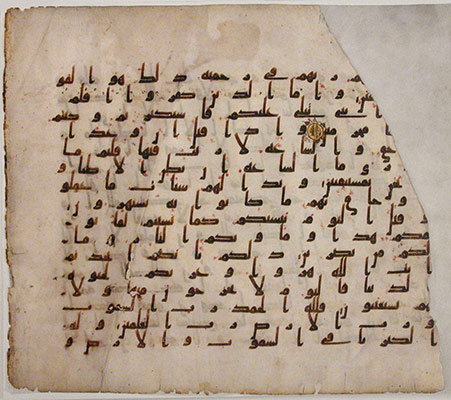 |
| See - no vowel marks (the dashes and lines under and over arabic script that are absent here) |
Last note on Toorawa's lecture: Islam defined itself to an extent against Christianity and Judaism as a religion which did away with the hierarchy necessary to communicate with God. Someone could recite the Qur'an (as our afternoon lecture said, in order to ingest divinity, rather in the same manner of the eucharist) and know God through God's word. No intermediary was necessary - people were meant to commune with Allah themselves.
This makes sense given the emphasis on prayer to Allah. We visited the second largest mosque in NY, at the Islamic Cultural Center of New York, where we were reminded that men and women pray separately. The Imam told us in admirably frank terms that this is to prevent distraction, especially for the men, from Allah, who should have their own focus. This is fine, although I think this repeated separation, especially when men are positioned in front of women, simply makes the men accustomed to being ahead of the women and in a better position than them, in the name of "reducing distractions".
Someone asked a great question at the end of Toorawa's talk: what role does Jesus play in the Qur'an and in the faith?
Here is a partial comment on what he said: Jesus is the prophet before Mohammad. In the Qur'an he does all the miracles attributed to him in the Bible. He is born of a virgin, he raises the dead, walks on water. He is even resurrected (though not crucified). It is as if the point is: this prophet was so so so amazing and still people disbelieved! Even his ministry didn't work on this world! So Mohammad came all those years later, and basically said "Here's a summary of everything the other prophets have told you, plus this: This is your last chance." Shape up. Account for your lives before someone else accounts for your lives on Judgment Day.Toorawa added that prophets also become increasingly fatherless. At first the link is clear: Adam is like God's son. The sons of Adam are humankind. Then things get harder with Abraham, who is asked to repudiate his father, and repudiates his son Isaac. This is hard to do - it's the hardest thing to repudiate one's father for the sake of something greater: God. Jesus doesn't have the same problem with this, because he doesn't have a father, and he doesn't have sons. So that's another way Jesus is more magical, or miraculous, or God-like than the others - this lack of father hang-up.
That's basically the end of today, except that in the afternoon we had a lecture on how Allah Is Beautiful and Loves Beauty. The lecturer was Zain Abdullah of Temple University. The point he made that I liked, even though it's very simple, is that most Muslims don't speak Arabic (only 15% are arab) so it's not the meaning of the Qur'an which keeps them coming back. It's the beauty. There is something about the religion which appeals to our delight in beauty, and that is the glue that keeps one in the faith.
I think this is true for me of Quakerism too. I find the silence beautiful. The model of community beautiful. The simplicity beautiful. Even when considered with the difficult and frustrating parts of Quaker practice, there is an overarching to the ideals and practice of the religion which bind me to it.
A word on PrideToday the idea of Pride was mentioned several times as being the root of all sin. Abdullah elucidated that Pride of appearance is not the issue, in itself. It's not bad to want to look nice and have polished shoes and pressed shirts. It's bad to do two things:
1. look down on others2. knowingly ignore the truth
Therefore in order to be humble, we must see ourselves as equal with others, joined in the chorus of singers, shoulder to shoulder, and we must look the truth in the face and act according to what Allah demands of us once we are aware of the truth. That's all!


No comments:
Post a Comment