It rained hard this afternoon, and I arrived home quite wet. My Composition notebook is several stages closer to Decomposition, but I have less to recount than I did yesterday, because a) a chunk of today I didn't really understand or feel engaged by and b) in the afternoon session we did calligraphy for about an hour, so I have no notes, but a painting.
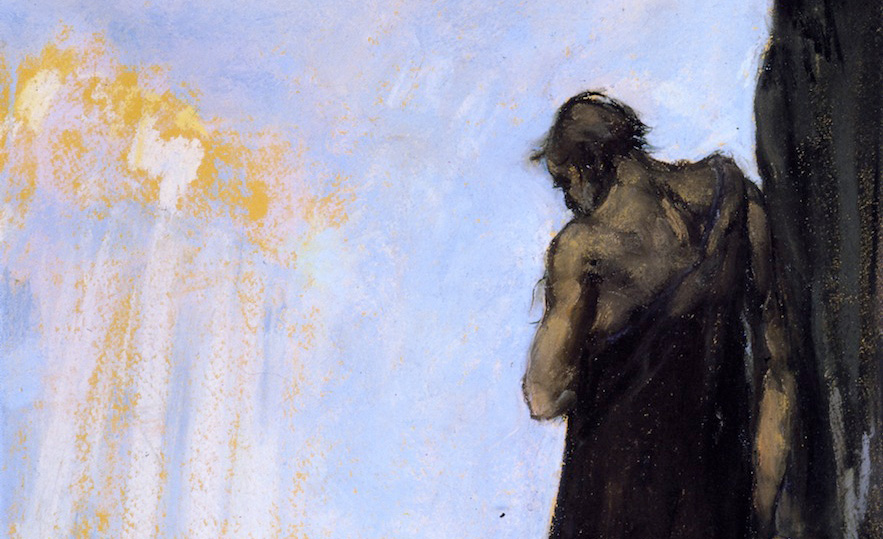 Moses is aware that his people don't believe, and he desires to offer them reassurance. He says to God, "Please, show yourself to me, so I can report to my people that I've seen you." God says, "If I show myself to you, you'll die. I'll show myself to that mountain, and you stay where you are and watch." God shows himself to the mountain and the mountain trembles and then breaks apart and disintegrates. Moses faints.

 |
| Me and two other scholars before our visit to the Mosque yesterday |
This morning Muhsin al Musawi of Columbia University spoke to us of Sufi poetry. There were several interesting ideas. Principally in relation to love. If one reads sufi poetry, it is easy to think that the Sufis were obsessed with drinking and romantic love. But the drink is really only alluding to the intoxication that Sufis seek by communing with god. Their wine, as Musawi said, is not our wine.
| I think this image gets at the subsumption into the divine. |
The goal of Sufism is to be in fact subsumed into the divine, to become one with it. This involves the entire annihilation of the self. Like a moth that is drawn to flame and finally dies when it comes in contact with the heat, a sufi seeks to be burned by her proximity to the divine. The goal is to lose oneself in the mystical experience that is divinity.
The erotic love between the poets and the young women they often write about is also divine in nature: the beauty that the sufi poets are attracted to in these women is really God, manifesting in them. I suppose this could be construed as something similar to the Quaker light of the divine within, though thankfully the Quakers don't have any conceptions of physical beauty as an indication of inner divinity!
But I must confess that whatever puritan streak remains in my upbringing makes me raise my eye brows at the alleged reverence motivating these poets. It seems like an easy way to justify lustful feelings while still considering oneself holy. (Here's an article from the NY that I read a few years ago about St. Augustine's brain child, original sin.)
But then, what is wrong with lust? It is only because of that Puritan streak, indeed, that I have the idea that erotic love is bad, or impure. What if our culture glorified even romantic love as one of the highest attainments, something natural, or more radically, divine in nature? I don't think Las Vegas would exist in that culture. We would not have the deep ambivalence and shame that results in such an outburst of incoherent and violent energy.
All the yearning that is done in sufi poetry is really yearning for God, because God is what we are attracted to in another person, or a place or thing. This was argued (either initially or most powerfully, I'm not sure) by Ibn Arabi, a poet born 1165.
I had forgotten about this Bible (and surely Qur'an) story, which al Musawi told to illustrate the Sufi desire to be annihilated in communion with God:
Moses is aware that his people don't believe, and he desires to offer them reassurance. He says to God, "Please, show yourself to me, so I can report to my people that I've seen you." God says, "If I show myself to you, you'll die. I'll show myself to that mountain, and you stay where you are and watch." God shows himself to the mountain and the mountain trembles and then breaks apart and disintegrates. Moses faints.
Isn't that great? Gotta love the Old Testament.
What about modern poets? Well, they don't have the courage to wish for self annihilation through communion with God (my words, not his). (By the way, I don't have the courage either). Modern poets believe in the visionary quality of poetic work, but are not about to self-abnegate through it; in fact they don't think it's possible to achieve that.
They should talk to the guy who was martyred by being gradually dismembered, laughing the whole way, because he had no consciousness of his body as physical. He was entirely one with the divine.
 |
| eL Seed Calligraffiti |
This afternoon we had a calligraphy workshop. We saw several of the scripts used in advanced calligraphy. Many were very hard to decipher, even for a reader of Arabic or Farsi or Urdu. It seemed that the emphasis was so clearly on the visual quality of the art, not just the meaning of the words conveyed. Imagine an English poetry volume in which the words can't be made out! Simply the depiction on the page carries enough significance of the beauty of the words.
 |
| A1one aka Tanha |
The presenter also showed us calligrafitti images from A1one aka Tanha and eL Seed, images that are unreadable but use letters as basic units.
I missed Utah a lot today, so my image depicts the mountains:


No comments:
Post a Comment