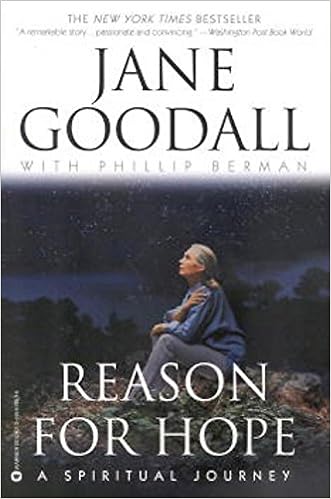
Jane Goodall's memoir, Reason for Hope, took a surprising and distressing turn yesterday. She describes how, after ten years of observing the chimpanzees at the Gombe Stream Research Center, she and the other researchers began observing brutally aggressive behavior in the chimps.
 Some of the adult males began beating up adult females with infants. They would often kill the infant. They would beat up the female. She often died of her injuries. Women also attacked other females, and even ate their babies. When one community broke into two groups at opposite ends of the reserve, one group continually attacked individual members of the other group while they were alone, until the breakaway troupe was all but annihilated.
Goodall found these events difficult not only because she knew these animals well and it was hard to see them turn on each other in such violence, but also because of the implications of these observations on their understanding of chimp nature. She was encouraged not to publish her findings, since publication would certainly provide fodder for scientists eager to justify human violence by claiming it was inherent in our genetic nature, inherited from our ape-like ancestors.
She published anyway, and this did in fact come to pass. Chimpanzees had a dark side to their nature, which illuminated some aspects of our own dark nature.
It is interesting to consider for oneself, quite free of scientific research, whether one thinks humans are naturally peaceful or naturally aggressive and hateful. I would say no, first off, but really there is overwhelming evidence on both sides of the argument. Children offer gifts and love freely and naturally. They also divide into factions and work for others' destruction. Adults do love each other, and especially their own children. They also create many artificial ways of separating themselves from others and justifying violence toward the "other" groups.
The chimps Goodall observed behaved not just to protect themselves, but to inflict major pain and suffering on each other. Does that mean this is what we will naturally do, after a time?
Marianne Williamson says "When people behave unlovingly, they have forgotten who they are." Is this what happened to the chimps? Our amnesia can be quite powerful, as induced by fear and socialization. I think it pretty conceivable that we can be "asleep at the wheel" and act in ways not in tune with our true nature. I hope that is where our violence comes from, not from our innate hatred of the other.
Here's a little video summary of the section I listened to yesterday.
I take comfort in the fact that I'm only half way through the book, and the title is Reason for Hope, so there must be a compelling uplift from this depressing revelation about chimps - that they can be just as vicious as we can.
Some of the adult males began beating up adult females with infants. They would often kill the infant. They would beat up the female. She often died of her injuries. Women also attacked other females, and even ate their babies. When one community broke into two groups at opposite ends of the reserve, one group continually attacked individual members of the other group while they were alone, until the breakaway troupe was all but annihilated. Goodall found these events difficult not only because she knew these animals well and it was hard to see them turn on each other in such violence, but also because of the implications of these observations on their understanding of chimp nature. She was encouraged not to publish her findings, since publication would certainly provide fodder for scientists eager to justify human violence by claiming it was inherent in our genetic nature, inherited from our ape-like ancestors.
She published anyway, and this did in fact come to pass. Chimpanzees had a dark side to their nature, which illuminated some aspects of our own dark nature.
It is interesting to consider for oneself, quite free of scientific research, whether one thinks humans are naturally peaceful or naturally aggressive and hateful. I would say no, first off, but really there is overwhelming evidence on both sides of the argument. Children offer gifts and love freely and naturally. They also divide into factions and work for others' destruction. Adults do love each other, and especially their own children. They also create many artificial ways of separating themselves from others and justifying violence toward the "other" groups.
The chimps Goodall observed behaved not just to protect themselves, but to inflict major pain and suffering on each other. Does that mean this is what we will naturally do, after a time?
Marianne Williamson says "When people behave unlovingly, they have forgotten who they are." Is this what happened to the chimps? Our amnesia can be quite powerful, as induced by fear and socialization. I think it pretty conceivable that we can be "asleep at the wheel" and act in ways not in tune with our true nature. I hope that is where our violence comes from, not from our innate hatred of the other.
Here's a little video summary of the section I listened to yesterday.
I take comfort in the fact that I'm only half way through the book, and the title is Reason for Hope, so there must be a compelling uplift from this depressing revelation about chimps - that they can be just as vicious as we can.


No comments:
Post a Comment