 |
| Quaker House |
Is it sentimentality alone which makes it such a pleasure to see the mossy trees and fences, and feel the absurd amount of water in the air? (Luckily my hair is so short right now it can't really curl.)
On Friday, the night before I arrived here, my hosts watched The Late Show with Stephen Colbert, which I have never seen. I have seen on clip of Colbert back on the Colbert Report, which I thought was funny - I don't remember the topic.
 |
| Love Thy Neighbor - very easy on this tiny, quiet road. |
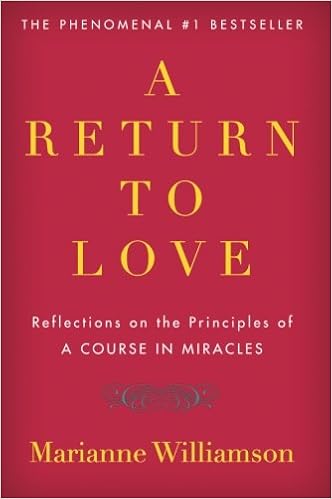
Because I don't read the news (or listen to it or watch it) I didn't know that the democratic debate had happened on Thursday. I also didn't know that Marianne Williamson was a candidate. I only learned her name a few weeks ago when a friend recommended her book A Return to Love.
I tried to hold Colbert's belittling comments about Williamson and her faith in the power of love at bay since I wanted to read her book without the taint of political satire (exactly none of which satire I found funny that night).
I started A Return to Love last night, and immediately was engaged by Williamson's description of how we see ourselves.
One idea I find fascinating in spirituality is that we are intent on experiencing the positive changes that a spiritual life promises, without giving up any of the patterns of thinking and acting upon which we presently rely. This, spiritual tradition tells us, is futile. We must give up all old ideas, relinquish ourselves entirely to the control of an outside being, forfeit all our previous ways of being, and embrace something foreign.

“Christ says, 'Give me All. I don't want so much of your time and so much of your money and so much of your work: I want You. I have not come to torment your natural self, but to kill it. No half-measures are any good...Hand over the whole natural self, all the desires which you think innocent as well as the ones you think wicked--the whole outfit. I will give you a new self instead. In fact, I will give you Myself: my own will shall become yours.'"
No half-measures are any good? That seems dramatic. I have never been able to commit wholly to a spiritual way of life. All my measures are half. I have never surrendered every aspect of my life to God's care. That sounds terrifying to me. My natural self is alive and kicking - perhaps kicking away Christ's suggestions of a fuller commitment to God's care. Actually, even that is inaccurate based on Lewis's ideas: Christ doesn't want a "fuller" commitment; any level of commitment short of the fully monty is futile.
But indeed I have not found this to be so. I think commitment on a grand scale is the ideal - an ideal I will work towards my whole life, but I do not expect my natural self to die unto God before it dies unto the world. Perhaps not either afterward, who says my spirit is any less headstrong and wilful than my human body?
Marianne Williamson also touches on the topic of surrender in her first chapter. She describes the "grandiose" moment when she invited God into her life.
 "I had thought that things would improve. It's as though my life was a house, and I thought God would give it a wonderful paint job -- new shutters perhaps, a pretty portico, new roof. Instead, it felt as though, as soon as I have the house to God, He hit it with a giant wrecking ball. 'Sorry, honey," He seemed to say, "There were cracks in the foundation, not to mention all the rats in the bedroom. I thought we better just start all over.'"
Starting all over with a new foundation - what does that look like? The first cornerstone I would like to jettison is the social expectations society places on women. Actually, since this is about rebuilding my house, not society's, I suppose the stone to remove is the one that contains my desire to adhere to society's expectations.
Still, though, reading this passage I hear myself ask (in a whiney tone) "Can't I put some supports in place and renovate without tearing the whole thing down?" Can't I let spirituality into my life without dying? The paradox is that we seek spirituality because we acknowledge, at some level, that we are not happy - that our lives are not what we want them to be. But really I just want to add some pleasant bells and whistles without removing any of the parts of myself that I am comfortable with, even if they are detrimental and cause pain.
One more return: I will attend unprogrammed worship at Durham Friends today.


No comments:
Post a Comment