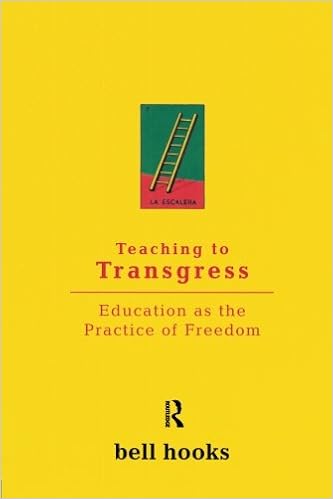
bell hooks reflects, in one of her essays in Teaching to Transgress, that if she had been able to take classes on critical race theory from progressive black professors rather than her progressive white professors, she would have, because those teachers, by dint of being black, would deliver the information differently because of the "spirit that orders the words" when they speak. There is a legitimacy, of course, that comes from being a minority, which changes the way students perceive content that is delivered to them.
I feel my own lack of legitimacy in this area as a white teacher when we consider thoughtful texts by black authors in my class. Yesterday we discussed Audre Lorde's "Poetry is Not a Luxury" and even though she speaks of women, not of black women or white women, I felt a certain gulf between myself and my students as I spoke with them about how Lorde exhorts us:
"We must constantly encourage ourselves and each other to attempt the heretical actions our dreams imply and some of our old ideas disparage."
A white teacher telling the students that we need to encourage each other feels a bit empty, frankly. I just imagine what these black students would feel if it were a black woman, or a black man, or a fellow refugee, speaking to them about the need to encourage each other. Of course I encourage them daily, but it's within a fairly proscribed academic context. I encourage them about their jobs and their sports pursuits, but I cannot pretend that we are really part of the same community, and they know it.
 What I felt very passionately, though I did not make this distinction in more than one class, is that as students they need to encourage each other. As friends, they need to encourage each other to look within, to face their fears, to "bear the intimacy of scrutiny, and to flourish within in," so we can "learn to use the products of that scrutiny for power within our living," which causes "those fears which rule our lives and form our silences [to] begin to lose their meaning."
hooks talks about the importance of individual experience in the classroom as a legitimate way of knowing, especially the experience of oppressed groups, like women and minorities. I feel much better about my ability to create a space in the classroom for the sharing of this kind of experience, as a white female teacher. Still, listening to her makes me want to be a principal just so I can search out and hire teachers of color, which our system so desperately needs.
Yesterday many of the young women in my class (and many men as well, in fact) knocked my socks off with their comments about the essay. Only maybe 30-40% of the students in each class spoke during our 15-20 minute circle discussion, but the things that were shared were thoughtful and, I trust, impacted the thinking of everyone in the room.
In perhaps my favorite moment all day, MN asked, "Miss, what does she mean by 'poetry is the skeleton architecture of our lives'?" I was unsure what to say, because indeed that phrase flummoxed me each of the half dozen times I read and annotated this essay in preparation for class. Luckily, MA jumped in with a response before I even could pose the question to the class - and she very rarely does that! She said "It means it's the most important thing. It's the thing that all our other action depends on." I was astounded by the ease and clarity of her interpretation. Of course, that makes perfect sense and is a powerful vision of poetry, and totally in line with Lorde's thrust in this essay, that poetry is not a luxury. Neither, I said to the class, is our literal skeleton a luxury - "We would fall down without it" mused SH. MN jumped onto MA's comment - "Ah, so she's saying we need to look inside ourselves to find it!" Again, this deepened my own understanding of Lorde's concept of poetry as skeleton.
In the first period, the conversation focused on fear and the ways it keeps us silent. Lorde's comment about how fears keep us silent and that, by putting them under "scrutiny" we can begin to be free of them, spurred a conversation of what kinds of fears make us silent.
Fear of actually facing violence, said ZE.
Fear of facing incarceration if we are guilty, said DI.
Fear of people's reactions if we tell them we are sick, like if we have HIV, said AM.
Fear of being abused, or of telling someone that we've been abused, said MY.
Fear of angry parents if we tell them that we are in a relationship, said AA.
Before we read Lorde's words about encouraging each other, I asked students how we overcome these fears. They said "raise your voice; be confident" and I said that those things are hard. How do we gain the confidence to raise our voice? Practice, they said, and encourage each other. This is exactly what Lorde tells us, I said. We looked at the section where Lorde says that "We can train ourselves to respect our feelings, and to discipline (transpose) them into a language that matches those feelings so they can be shared. And where the language does not yet exist, it is our poetry which helps to fashion it."
 We had just written poetry at the beginning of class, a stanza of lines all of which began with "I". When we reached this point in the discussion, we could say "That was training. Lorde would congratulate us here on doing the hard work of looking within and asking 'What and who am I?'" We then talked, in both first and second periods, about what that takes courage. Why is it hard to turn the spotlight towards ourselves?
Because sometimes we've made mistakes and done things we don't want to look at, said MN.
Because we like to put the past in the past, and pretend it has no power, said ZA.
_________
At the beginning of the period, as I told the classes that their homework was to read two poems by Langston Hughes, I said that it was his poetry was caused me to like poetry. "I didn't like any of the poetry we read in high school," I told them, to which RA said "Me neither!" I thought this was great, I always love the candor of what RA says. So I said "I'm so glad you said that, because it reminds me to say to you, even if you don't like any of the poetry we are reading now, don't give up on poetry, because there are a million kinds, and you might connect really well to some other kind of poetry. Don't do what I did, which is graduate thinking 'aw, poetry is just not for me.'"
I was going to make a comparison to what people have told me about beer - "you just haven't found the right one yet!" But I didn't.
I've been thinking what kind of academic writing I could do about what goes on in my classroom, and I feel like reflecting on being a white teacher in a classroom of African and Asian and South American students might be fruitful line of inquiry to pursue.
I feel my own lack of legitimacy in this area as a white teacher when we consider thoughtful texts by black authors in my class. Yesterday we discussed Audre Lorde's "Poetry is Not a Luxury" and even though she speaks of women, not of black women or white women, I felt a certain gulf between myself and my students as I spoke with them about how Lorde exhorts us:
"We must constantly encourage ourselves and each other to attempt the heretical actions our dreams imply and some of our old ideas disparage."
A white teacher telling the students that we need to encourage each other feels a bit empty, frankly. I just imagine what these black students would feel if it were a black woman, or a black man, or a fellow refugee, speaking to them about the need to encourage each other. Of course I encourage them daily, but it's within a fairly proscribed academic context. I encourage them about their jobs and their sports pursuits, but I cannot pretend that we are really part of the same community, and they know it.
What I felt very passionately, though I did not make this distinction in more than one class, is that as students they need to encourage each other. As friends, they need to encourage each other to look within, to face their fears, to "bear the intimacy of scrutiny, and to flourish within in," so we can "learn to use the products of that scrutiny for power within our living," which causes "those fears which rule our lives and form our silences [to] begin to lose their meaning."hooks talks about the importance of individual experience in the classroom as a legitimate way of knowing, especially the experience of oppressed groups, like women and minorities. I feel much better about my ability to create a space in the classroom for the sharing of this kind of experience, as a white female teacher. Still, listening to her makes me want to be a principal just so I can search out and hire teachers of color, which our system so desperately needs.
Yesterday many of the young women in my class (and many men as well, in fact) knocked my socks off with their comments about the essay. Only maybe 30-40% of the students in each class spoke during our 15-20 minute circle discussion, but the things that were shared were thoughtful and, I trust, impacted the thinking of everyone in the room.
In perhaps my favorite moment all day, MN asked, "Miss, what does she mean by 'poetry is the skeleton architecture of our lives'?" I was unsure what to say, because indeed that phrase flummoxed me each of the half dozen times I read and annotated this essay in preparation for class. Luckily, MA jumped in with a response before I even could pose the question to the class - and she very rarely does that! She said "It means it's the most important thing. It's the thing that all our other action depends on." I was astounded by the ease and clarity of her interpretation. Of course, that makes perfect sense and is a powerful vision of poetry, and totally in line with Lorde's thrust in this essay, that poetry is not a luxury. Neither, I said to the class, is our literal skeleton a luxury - "We would fall down without it" mused SH. MN jumped onto MA's comment - "Ah, so she's saying we need to look inside ourselves to find it!" Again, this deepened my own understanding of Lorde's concept of poetry as skeleton.
In the first period, the conversation focused on fear and the ways it keeps us silent. Lorde's comment about how fears keep us silent and that, by putting them under "scrutiny" we can begin to be free of them, spurred a conversation of what kinds of fears make us silent.
Fear of actually facing violence, said ZE.
Fear of facing incarceration if we are guilty, said DI.
Fear of people's reactions if we tell them we are sick, like if we have HIV, said AM.
Fear of being abused, or of telling someone that we've been abused, said MY.
Fear of angry parents if we tell them that we are in a relationship, said AA.
Before we read Lorde's words about encouraging each other, I asked students how we overcome these fears. They said "raise your voice; be confident" and I said that those things are hard. How do we gain the confidence to raise our voice? Practice, they said, and encourage each other. This is exactly what Lorde tells us, I said. We looked at the section where Lorde says that "We can train ourselves to respect our feelings, and to discipline (transpose) them into a language that matches those feelings so they can be shared. And where the language does not yet exist, it is our poetry which helps to fashion it."
 We had just written poetry at the beginning of class, a stanza of lines all of which began with "I". When we reached this point in the discussion, we could say "That was training. Lorde would congratulate us here on doing the hard work of looking within and asking 'What and who am I?'" We then talked, in both first and second periods, about what that takes courage. Why is it hard to turn the spotlight towards ourselves?
 Because sometimes we've made mistakes and done things we don't want to look at, said MN.
Because we like to put the past in the past, and pretend it has no power, said ZA.
_________
At the beginning of the period, as I told the classes that their homework was to read two poems by Langston Hughes, I said that it was his poetry was caused me to like poetry. "I didn't like any of the poetry we read in high school," I told them, to which RA said "Me neither!" I thought this was great, I always love the candor of what RA says. So I said "I'm so glad you said that, because it reminds me to say to you, even if you don't like any of the poetry we are reading now, don't give up on poetry, because there are a million kinds, and you might connect really well to some other kind of poetry. Don't do what I did, which is graduate thinking 'aw, poetry is just not for me.'"
I was going to make a comparison to what people have told me about beer - "you just haven't found the right one yet!" But I didn't.
I've been thinking what kind of academic writing I could do about what goes on in my classroom, and I feel like reflecting on being a white teacher in a classroom of African and Asian and South American students might be fruitful line of inquiry to pursue.


No comments:
Post a Comment